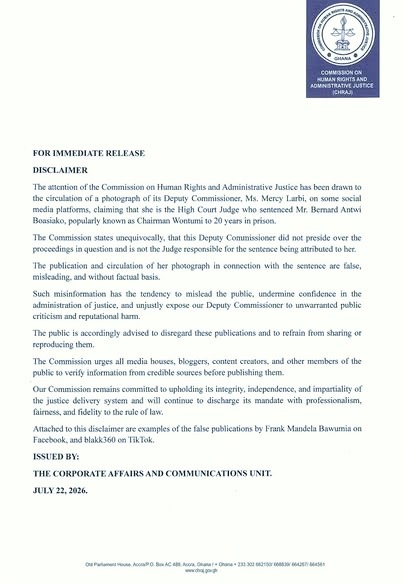

The Commission on Human Rights and Administrative Justice (CHRAJ) has dismissed as false claims circulating on social media that its Deputy Commissioner, Mercy Larbi, presided over the High Court proceedings that sentenced New Patriotic Party (NPP) Ashanti Regional Chairman Bernard Antwi Boasiako, popularly known as Chairman Wontumi, to 20 years’ imprisonment.
In a disclaimer issued on Wednesday, July 22, CHRAJ said posts shared by a Facebook user identified as Frank Mandela Bawumia and the TikTok account blakk360 wrongly identified Mrs Larbi as the judge who delivered the sentence.
The Commission stressed that Mrs Larbi neither presided over the case nor had any involvement in the proceedings.
“The publication and circulation of her photograph in connection with the sentence are false, misleading, and without factual basis,” the statement said.
CHRAJ warned that the publication could mislead the public, undermine confidence in the justice system and unfairly expose its Deputy Commissioner to criticism and reputational harm.
It urged the public to disregard the claims and avoid sharing or reproducing the false information.
The Commission also called on media organisations, bloggers, content creators and the general public to verify information through credible and official sources before publishing or sharing content.
“Our Commission remains committed to upholding its integrity, independence and impartiality of the justice delivery system and will continue to discharge its mandate with professionalism, fairness and fidelity to the rule of law,” the statement added.
The clarification follows the sentencing of Chairman Wontumi by the High Court in Accra in the Akonta Mining illegal mining case.
Justice Audrey Kocuvie-Tay convicted Wontumi on Counts One and Four and sentenced him to 20 years’ imprisonment on each count, with the sentences to run concurrently. He was also fined 10,000 penalty units on each count.
Akonta Mining Limited, which was convicted on Counts Three and Six, was fined 15,000 penalty units on each count after the court found that the prosecution had proven the essential elements of the offences beyond reasonable doubt.