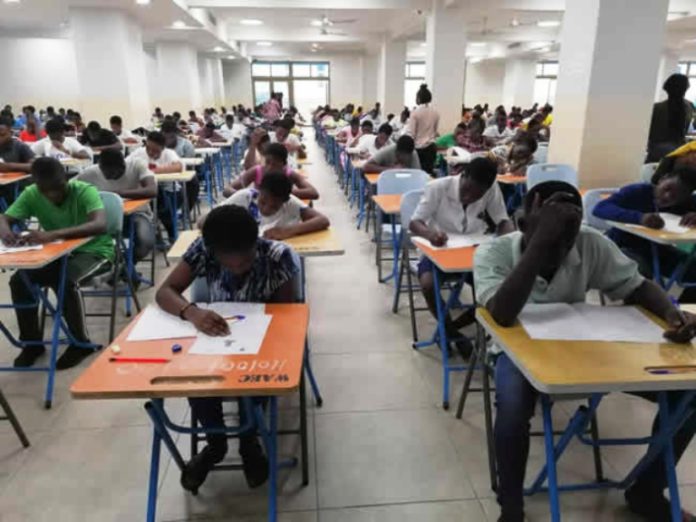

The Chief Examiner’s Report has outlined various reasons why candidates performed poorly in three of the four core subjects in this year’s West African Senior School Certificate Examination (WASSCE) for School Candidates (SC).
The reasons are contained in a summary of the weaknesses of candidates in the 2025 WASSCE-SC (Ghana Only Version).
Mathematics
In Mathematics, the report listed seven reasons, including candidates showing weaknesses in representing mathematical information in diagrams, solving global maths-related problems, constructing cumulative frequency tables and making deductions from real-life problems.
They also showed weaknesses in solving simple interest applications, translating word problems into mathematical expressions and interpreting results from cumulative frequency data.
“The Chief Examiner for Mathematics (Core) reported that there was a decline in performance compared to that of the previous year,” it said.
Regarding candidates’ strengths, the report said they were evident in the application of the midpoint concept to solve problems, solving problems on mensuration, solving simple problems on average speed and finding the distance of a line when given two points.
Social Studies
On Social Studies – the integrated study of the social sciences and humanities to promote civic competence – the Chief Examiner indicated that candidates could not point out how expensive funerals adversely affected the development of the Ghanaian society.
They could also not answer the question on policies implemented by the government to better the lives of the people, and they could not sufficiently discuss the forms of cooperation Ghana has with the United Nations organisations.
On their strengths, the Chief Examiner said most of the candidates demonstrated excellent understanding of Abraham Maslow’s Hierarchy of Needs Theory and how it could be applied to the lives of students.
Again, they were to point out the influence of Western formal education on the social outlook of the Ghanaian and were able to explain how rapid population growth adversely affects the physical environment.
Most of the candidates were able to discuss measures an individual could adopt to better his or her socio-economic life in Ghana.
Integrated Science
With regard to Integrated Science, the Chief Examiner indicated that candidates’ performance was poor in some areas.
They were definitions of relative atomic mass, graph work and calculation of slope, wrong spelling of key scientific terminologies, drawing of bar magnet and lines of force, description of post-harvest practices such as winnowing, dehusking and shelling, reagents for testing foods in the laboratory and drawing of genetic diagrams.
However, the candidates were able to show strength in energy transformation, the mole concept or definition of standard solution, advantages of parallel wiring in homes, challenges of pig production in Ghana and significance of the stages of water treatment for public consumption.
WASSCE performance
In the Mathematics paper for this year’s WASSCE-SC, 209,068 (48.73 per cent) had A1-C6; 52,991 (11.62 per cent) had D7; 52,145 (12.15 per cent) obtained E8, while 114,872 (26.77 per cent) had F9.
For Integrated Science, 220,806 (57.74 per cent) candidates scored A1-C6; 54,580 (11.85 per cent) had D7; 45,783 (11.79 per cent) recorded E8, while 61,243 (16.05 per cent) obtained F9.
Another core subject, Social Studies, had 248,538 (55.82 per cent) candidates scoring A1-C6, with 33,670 (7.38 per cent) candidates recording D7, while 40,608 (9.12 per cent) had E8, and 122,449 (27.50 per cent) settled for F9.
In English Language, 289,673 (60 per cent) of the candidates scored between A1-C6; 37,712 (8.18 per cent) others had D7; 39,091 (9.23 per cent) had E8, and 54,294 (12.86 per cent) had F9.
A detailed Chief Examiner’s Report on the performance of candidates in the WASSCE is expected to be issued by the West African Examinations Council (WAEC) later.
Mathematical association
Meanwhile, the Mathematical Association of Ghana (MAG) has said the poor performance in mathematics is due to the students’ lack of comprehension of the English language.
It said that once students did not have the skill to read and comprehend, they could not do Core Maths.
“The poor performance in mathematics is due to the students’ comprehension of the English language, because mathematics is written in English.
So they have to translate the English language to mathematical language before they can solve the problem,” the Vice-President of MAG, Timothy Dougbatey, said in an interview with the Daily Graphic yesterday.
He said Mathematics also needed constant practising and that was what the students needed to imbibe in order to become perfect, and that students would have to discipline themselves by doing that.
“You can’t just take the book and be reading.
You need to get a pencil or a pen,” he said, and that “you have to get a book, you have to get a jotter, or you have to get a marker board.
Then you have to start solving the questions,” he said, adding that constant practice was a challenge for the students.
On the teachers, Mr Dougbatey observed that they taught areas of specialisation and were not doing general teaching.
“So when the students also learn areas of specialisation, and they go (to the exam halls), and the questions are different, then they are found wanting.
“So, for the part of teachers, we have to teach everything in the syllabus, whether it is our strength or weakness in the knowledge of that topic.
We need to relearn and relearn and relearn and then come and teach the students to do exactly what is expected of them.
Then the parents might also monitor their students constantly,” he stated.
The MAG Vice-President indicated that parents should ensure that their children practised and solved past questions to become familiar with the format.
Mr Dougbatey said the association would also organise training programmes for teachers to upgrade their knowledge.
He said the poor performance in Core Maths began as far back as 2006 and that the association realised that students did not have in-depth knowledge of English language comprehension.
ALSO:
GTEC warns public against six unaccredited University of Ghana learning centres
2025 WASSCE: We must stop thinking students are not brilliant –…