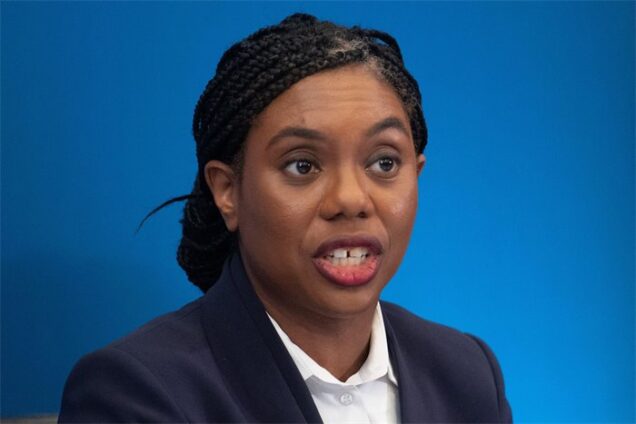

The leader of the UK Conservative Party, Kemi Badenoch, has taken aim at the Labour government’s foreign policy, accusing Prime Minister Keir Starmer of failing to shield British taxpayers from what she described as potential “trillions in reparations” at the United Nations.
The criticism follows the United Kingdom’s decision to abstain from a significant resolution at the United Nations General Assembly, alongside 51 other countries, many of them members of the European Union.
The motion, led by Ghana, formally recognises the Trans-Atlantic Slave Trade as the “gravest crime against humanity” and proposes a structured path toward reparatory justice.
While countries including the United States, Israel and Argentina voted against the resolution, the UK’s neutral stance has sparked debate at home over historical responsibility and possible financial implications.
Reacting on social media platform X, Mrs Badenoch questioned the government’s position, arguing that Britain’s historical role in ending slavery should have informed a different response.
“Russia, China and Iran vote with others to demand trillions in reparations from UK taxpayers…and the Labour government abstain! Britain led the fight to end slavery. Why didn’t Starmer’s representative vote against this? Ignorance…or cowardice? We shouldn’t be paying for a crime we helped eradicate and still fight today,” she wrote.
Her concerns echo arguments from some economists who caution that, although resolutions of the General Assembly are not legally binding, they can create a strong moral and political basis for future legal claims against states or institutions.
Russia, China and Iran vote with others to demand trillions in reparations from UK taxpayers…and the Labour government abstain!
— Kemi Badenoch (@KemiBadenoch) March 26, 2026
Britain led the fight to end slavery.
Why didn’t Starmer’s representative vote against this? Ignorance…or cowardice?
We shouldn’t be paying for a… https://t.co/nWlzBxhb5w
In New York, however, proponents of the resolution rejected suggestions that the initiative is aimed at extracting direct financial payments from Western governments. Ghana’s Foreign Affairs Minister, Samuel Okudzeto Ablakwa, clarified that the focus is on long-term development and restorative justice.
“We are demanding compensation – and let us be clear, African leaders are not asking for money for themselves. We want justice for the victims and causes to be supported, educational and endowment funds, skills training funds,” he stated.
He further explained that Ghana’s objective is to ensure that the lasting effects of the trade, through which an estimated 12.5 million Africans were forcibly taken across the Atlantic, are properly acknowledged and addressed through historical accountability.
The resolution secured broad backing, passing with 123 votes in favour, marking a significant moment for the African Union’s reparations agenda. President John Dramani Mahama, who has emerged as a leading voice on the issue, described the outcome as a pivotal step in confronting history.
“Let it be recorded that when history beckoned, we did what was right for the memory of the millions who suffered the indignity of the slave trade and those who continue to suffer racial discrimination. The adoption of this resolution serves as a safeguard against forgetting. It also challenges the enduring scars of slavery,” he told the assembly.
The UK’s abstention aligns it with a group of countries that found aspects of the resolution, particularly references to reparations frameworks, difficult to endorse, yet stopped short of outright opposition. The decision has highlighted divisions within Europe on how best to approach the legacy of slavery.
Historians note that while Britain played a major role in the slave trade for more than two centuries, it later became a leading force in its suppression, notably through the Royal Navy’s West Africa Squadron after 1807.
Mrs Badenoch has argued that this legacy should weigh heavily in how the country is judged in contemporary debates.
The Starmer administration has not formally responded to her remarks, though reports from Whitehall suggest the abstention was intended to balance diplomatic relations, particularly within the Commonwealth, while avoiding any binding commitment to reparations.
ALSO READ: