


The drive for robust and transparent teacher regulatory frameworks has brought delegations from Tanzania and Namibia to Ghana, as both countries seek to establish teacher regulatory bodies that go beyond licensing and CPD procedures to foster professional excellence, accountability, and continuous improvement across their education systems.
The Namibian delegation spent five days in Accra on a government-facilitated study visit. Upon their arrival, Dr. Christian Addai-Poku, Registrar and CEO of the National Teaching Council (NTC), assigned Dr. Cecilia Agbe (Deputy Registrar) and Dr. Lawrence Sarpong (Director for Higher Education) to guide the team through Ghana’s teacher-regulatory ecosystem. The programme covered licensing and registration processes, the Continuous Professional Development (CPD) framework, and the point-based CPD system. It also highlighted three home-grown technology innovations:
- Teacher Portal Ghana – a digital platform developed by Next Dev Technologies linking teacher data, CPD transcripts, digital portfolios, the teacher register, and a marketplace of CPD service providers.
- Technology-Induced Coaching and Mentoring Model – created by Samuel Nuamah Boakye, this digital-first system pairs newly qualified teachers with experienced mentors, tracks mentoring hours, and integrates outcomes into CPD records.
- Teacher Learning Accountability System (TLAS) – also developed by Samuel Nuamah Boakye, this automated suite validates CPD points, flags non-compliance, and generates real-time dashboards for school leaders and regulators.
All three initiatives were implemented under the guidance of Dr. Lawrence Sarpong, supervised by Dr. Christian Addai-Poku.
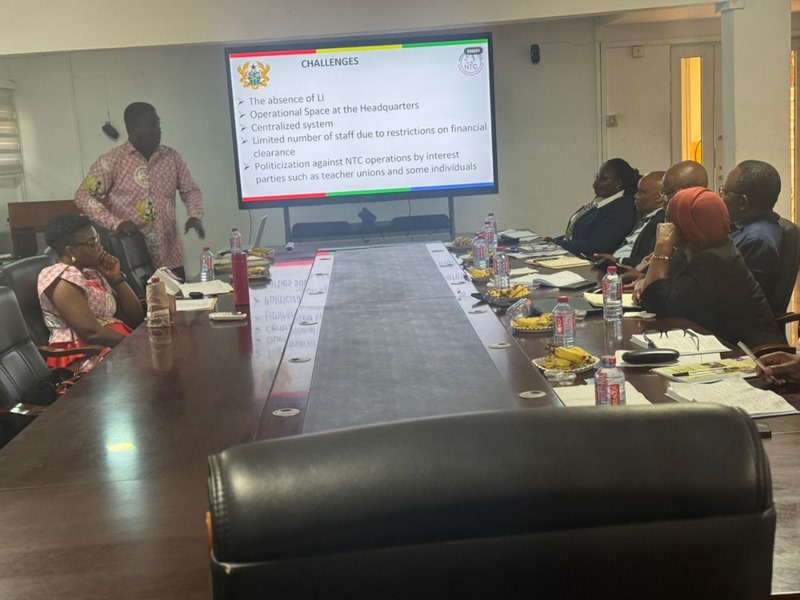
The Tanzanian delegation attended a one-day intensive programme arranged by their government. Dr. Addai-Poku assigned them to Dr. Sarpong and Ms. Araba Eduafo, who provided a focused overview of the regulatory and professional development components previously shared with Namibia.
Ghana’s delegation later engaged with Uganda’s Ministry of Education on December 1, 2025, at the Golden Tulip Hotel in Kampala, sharing best practices as part of the Regional Teacher Initiative for Africa (RTIA).
Institutional Architecture
Unlike centralized models in some African countries, Ghana and Nigeria operate decentralized systems, separating the employer’s role from regulatory functions. Kenya and Sierra Leone, by contrast, combine both roles under a single authority. Ghana has refined its approach further by establishing three zonal centres—Northern, Middle, and Southern regions—which serve as operational hubs to streamline registration, CPD accreditation, and support for Teacher Portal Ghana.
Legislative Momentum in Uganda and Namibia
Both Namibia and Uganda now have draft legislation under parliamentary review to establish their own teaching regulatory bodies. If enacted, these councils are expected to be operational before the Africa Federation of Teaching Regulatory Authorities (AFTRA) conference in Botswana in May 2026, building on Ghana’s benchmark model.
Comparative Overview of African Models
During his Uganda presentation, Dr. Addai-Poku outlined regulatory approaches across the continent:
- Ghana and Nigeria – decentralized, separating employer functions from regulation.
- South Africa – decentralized, with provincial councils reporting to a national authority.
- Zambia – similar to Ghana and Nigeria, with statutory backing and a points-based CPD system.
- Kenya and Sierra Leone – combine employer and regulatory functions under one entity.
This comparative analysis provided Ugandan officials with a clear view of effective regulatory models.
Why Ghana’s System Stands Out
Ghana’s teacher regulatory framework is recognized internationally, with countries such as the UK, Canada, the US, Jamaica, and Australia granting reciprocal recognition to Ghanaian teachers. Key differentiators include:
- Transparent, point-based CPD that generates verifiable transcripts for every professional development activity.
- Technology-driven CPD, allowing teachers to earn points remotely via an online learning management system.
- Teacher Learning Cycles (TLCs) – school-based action research projects embedding continuous improvement.
- Coaching and mentoring programmes pairing newly qualified teachers with experienced mentors.
Together, these innovations have positioned Ghana as a model of excellence in teacher training and development across Africa.
The Ghana Teacher Prize: A Magnet for Benchmark Visits
Every year from October 2–5, the National Teaching Council hosts the Ghana Teacher Prize to celebrate outstanding educators. Winners receive prizes including a three-bedroom house, 4×4 vehicle, salon car, motorbikes, laptops, scholarships, and cash awards. This initiative attracts international attention from countries seeking to emulate Ghana’s success.
Leadership Driving the Vision
Political and governance support has been crucial. Education Minister Hon. Haruna Iddrisu and NTC Board Chairman Emmanuel Kwami Alorvi have championed initiatives to make teaching an attractive profession, while Dr. Addai-Poku’s visionary leadership has strengthened Ghana’s reputation as a go-to country for teacher regulation.
Outlook: Broader African Impact
As Uganda, Tanzania, and Namibia establish their councils, the continent is entering a new era in teacher professionalism. Ghana’s contributions—from policy formulation and implementation to transparent CPD and the Ghana Teacher Prize—set the standard. The upcoming AFTRA conference in Botswana will highlight these achievements and reinforce the importance of quality teacher regulation as the foundation for quality education across Africa.
