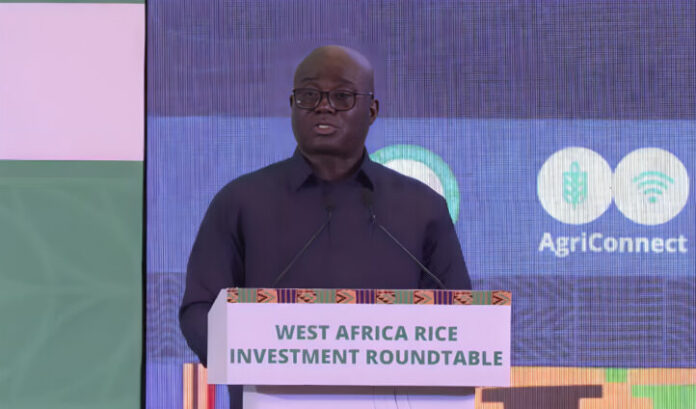

Minister for Food and Agriculture, Eric Opoku, has warned that African countries risk remaining vulnerable to external shocks and security threats if they fail to achieve food self-sufficiency.
Addressing lawmakers at the 4th African Inter-Parliamentary Conference on Family Sovereignty and Values in Parliament, he described food sovereignty as a critical national security issue, stressing that recent global crises have exposed the risks of dependence on international food supply chains.
He noted that developments over the past three decades have made the concept of food sovereignty more relevant than ever, citing the COVID-19 pandemic, the Russia–Ukraine conflict, climate-related disasters and rising geopolitical tensions as major disruptions to global food systems.
“These developments have taught a critical lesson: a nation that cannot feed itself remains vulnerable,” Mr Opoku stated.
He emphasized that food security should not be viewed solely as an agricultural concern, but as a strategic national security matter requiring urgent attention from governments across the continent.
The Minister explained that food sovereignty empowers countries to determine their own agricultural, fisheries, labour and land-use policies in line with national priorities and local needs. He said it also promotes locally produced food, culturally appropriate diets, environmental sustainability, equitable access to resources and democratic control over food systems.
Mr Opoku argued that Africa’s inability to feed itself is not due to a lack of natural resources, but rather policy and structural challenges.
Despite possessing vast arable land, favourable climatic conditions and a large agricultural workforce, he noted that Africa still contributes less than 10 per cent of global agricultural output.
He called for deliberate policy reforms and increased investment aimed at strengthening domestic food production, improving agricultural productivity and reducing dependence on food imports.
The Minister urged African leaders and lawmakers to prioritise food sovereignty as a cornerstone of economic resilience, national security and sustainable development.
READ ALSO:
Government pushes for local lithium processing and battery production