

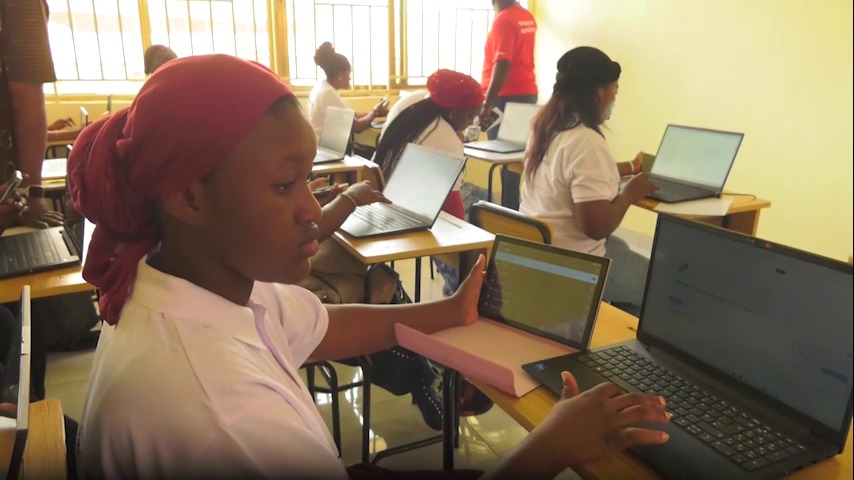
In a major boost for women’s participation in Ghana’s digital economy, 150 women from the Ashanti, Bono East and Northern regions have successfully acquired digital and coding skills under the African Girls Can Code Initiative (AGCCI).
The transformative initiative, a collaboration between the Government of Ghana and the International Telecommunication Union (ITU), is designed to bridge the persistent digital gender gap and equip women with the skills needed to leverage technology for business growth, employability and professional advancement.
The graduation and certification ceremony held in Kumasi was filled with excitement as beneficiaries, many of whom are into fashion design, catering, hairdressing, entrepreneurship, healthcare and engineering, showcased projects they had developed during the training.
For years, Ghana has made significant strides in promoting digital inclusion through programmes such as Girls-in-ICT, which targets basic school girls.
However, a huge gap remains for adult women who are already active in the informal sector and tertiary institutions but lack the digital skills to scale up their work.

From fashion designers who want to sell their products online, to caterers who want to manage bookings digitally, and engineering students who need coding skills for their academic work, the need for practical digital training has become more urgent than ever.
It is this critical gap that the African Girls Can Code Initiative seeks to fill.
The programme provides intensive, hands-on training in highly relevant areas including introduction to computer programming and coding, data analytics, cybersecurity awareness and digital safety, graphic design, website development, and digital marketing and e-commerce.
Speaking at the event, the Administrator of GIFEC, Mr. Sofo Tanko Rashid, explained that the initiative is a strategic shift from the well-known Girls-in-ICT programme.
“Unlike the existing Girls-in-ICT programme which targets young girls at the basic school level to create interest in ICT, this initiative focuses on women already engaged in vocational activities, entrepreneurship and tertiary education,” he said.
“We realized that many women have the talent and the business ideas, but they lack the digital tools to scale up. This programme is designed to give them immediately applicable skills to transform their businesses and careers.”
Mr. Rashid noted that GIFEC is committed to ensuring that no one is left behind in Ghana’s digitalization agenda, especially women and girls in underserved communities where access to digital tools and internet connectivity remains a challenge.
For the beneficiaries, the training has been life-changing and is already translating into practical solutions.
Several women shared how they can now independently design business logos, flyers and product labels using graphic design tools, create simple business websites, run targeted advertisements on Facebook, Instagram and TikTok, and use WhatsApp Business and other digital tools to manage customer orders and payments.
“I never thought I could write a line of code. Today I have built a simple website for my department. This programme has shown me that technology is not just for men,” a beneficriary said.
Participants Call For Annual Programme And Curriculum Integration
While expressing gratitude to the government and GIFEC, some of the participants appealed for the programme to be sustained and institutionalized.
They called on the government and the Ministry of Education to adopt the African Girls Can Code Initiative into the formal curriculum for vocational and technical institutions, and to ensure that it becomes an annual event rather than a one-off intervention.
According to them, making it part of the curriculum and organizing it annually would give more women, especially those in rural and deprived communities, the opportunity to acquire digital skills and stay competitive in the fast-changing digital world.
“If this programme can be added to what we learn in vocational school or organized this program every year, more women will benefit. Many of our colleagues back home do not know how to even use a computer to promote their businesses,” a beneficiary from the Ashanti Region noted.
The Acting Municipal Education Director for Kwadaso, Mr. Henaku Budu, commended the government, ITU and GIFEC for the initiative, describing it as timely and essential.
He observed that in a rapidly evolving world driven by artificial intelligence and digital technology, digital skills have become as fundamental as reading and writing.
“Digital skills are no longer optional; they are essential. Every profession today requires some level of digital literacy. If we empower our women who dominate the informal sector with these skills, we are directly empowering the Ghanaian economy,” Mr. Budu stated.
He urged the beneficiaries to not keep the knowledge to themselves but to serve as digital ambassadors in their communities by mentoring and training other women and girls.
The African Girls Can Code Initiative forms part of broader efforts by the Ministry of Communication, Digital Technology and Innovations and GIFEC to promote digital inclusion and ensure women are not left behind as Ghana transitions towards an increasingly digital economy.
The programme is being implemented across several African countries under the partnership of ITU, UN Women and the African Union Commission, with the objective of training thousands of young women in digital skills and preparing them for decent jobs and entrepreneurship in the tech ecosystem.
The Ghana Investment Fund for Electronic Communications (GIFEC), which is spearheading the implementation of the programme in Ghana, has announced plans to scale up the initiative to benefit 500 women next year following the success of the maiden cohort.
The 150 women were presented with certificates of participation and start-up digital toolkits to help them kick-start the application of the skills acquired.