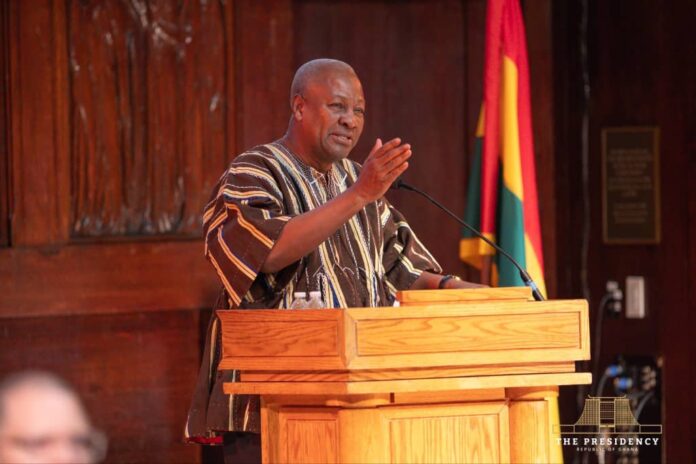

President John Mahama has called for a major rethink of healthcare financing in Africa, urging governments and investors to treat the sector as an economic investment rather than merely a cost to national budgets.
According to President Mahama, increased investment in healthcare can drive economic growth, create jobs, strengthen human capital and support macroeconomic stability across the continent.
He made the call at the Health Plenary of the Alamein Africa Forum in Egypt.
President Mahama said African finance ministers and global investors have for years treated healthcare as a social expenditure that should be funded only when resources are available.
“African finance ministers and global investors have made a fundamental error. They have treated health as a line-item cost and a social expenditure in their budgets to be funded only when there is money left over,” he said.
He urged stakeholders to move away from that approach, arguing that healthcare has significant economic potential.
“Health is not a charitable cost. It is an investable high-growth economic sector. It drives human capital, manufacturing, job creation, and macroeconomic stability,” President Mahama stated.
He cited research by the Copenhagen Consensus, which he said found that a targeted package of basic emergency, maternal and newborn care could generate $87 in economic and social returns for every dollar invested.
He also referenced the Lancet Commission, saying declining mortality rates accounted for nearly a quarter of total income growth in developing economies in the early 2000s.
“And so investing in healthcare strengthens our balance sheets rather than depleting resources,” he added.
Africa’s pharmaceutical gap
President Mahama also drew attention to Africa’s heavy dependence on imported medicines and vaccines, describing the situation as both a challenge and an opportunity for domestic investment.
“Africa imports over 70% of its pharmaceuticals and nearly 99% of its vaccines. Each year tens of billions of dollars leave African economies to purchase medicines and vaccines from abroad,” he said.
He noted that the situation is being compounded by declining traditional donor assistance, citing OECD projections that health aid could fall by between 29% and 46% compared with 2024 levels.
President Mahama said the decline in donor support should prompt African countries to mobilise domestic private capital and strengthen local pharmaceutical production.
“The situation presents not only a crisis but also a significant market opportunity for domestic private capital,” he said.
He identified Africa’s growing population as one of the key factors supporting the business case for local pharmaceutical manufacturing.
According to him, Africa’s population is projected to reach 2.5 billion by 2050, while demand for essential medicines, chronic disease management and biologics continues to grow.
President Mahama said African countries must therefore position healthcare and pharmaceutical manufacturing as strategic sectors capable of retaining more economic value on the continent while creating jobs and strengthening health security.