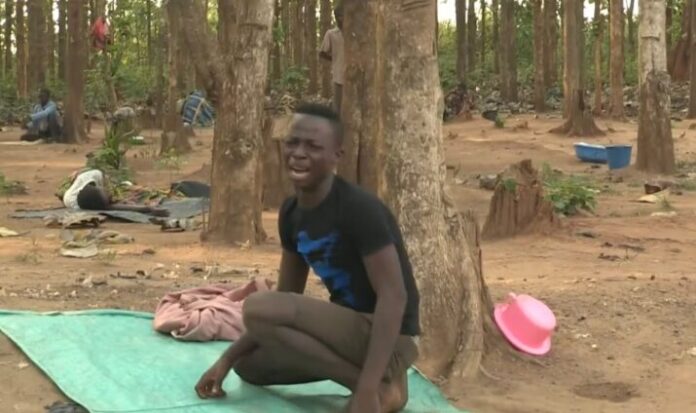

At eight years old, Hafiz Abdallah was taken to Nyinbonya, a prayer camp in Paga, near Ghana’s border with Burkina Faso.
He is now 16.
For eight years, his mother says, her son has lived at the facility without a clinical diagnosis.
When his behaviour becomes erratic, she says, he is chained.
“He doesn’t even speak, stands often in his own world,” she said. “But this helped me a lot because I am very much assured that he will not wander off and end up getting hurt or killed.”
Hafiz became increasingly difficult to manage after the death of his twin brother. He destroyed things, once stole a neighbour’s chicken and often attacked his mother.
She said she did not understand what was wrong with him.
“I tried herbal remedies and spent money I did not have. Over eight years, my savings are exhausted.”
“Where else do I turn to? I put my faith in Allah,” she said.
Her story points to a wider problem: for some Ghanaian families, the first response to unexplained or disturbing behaviour is not a mental-health clinic but a church, prayer camp or traditional healer.
Clinical psychologist and University of Ghana lecturer Emmanuel Asampong says this is partly rooted in how illness is understood.
“We have usually, if you like, relied on what we would say is a biopsychosocial approach to seeking health,” he said.
“When things happen to people, and they are not able to explain it easily, then they are quick to attribute it to some spiritual dimension.”
For children whose conditions require professional assessment, that can mean being treated elsewhere — sometimes for years.
Inside Nyinbonya
At Nyinbonya, children and adults were seen walking barefoot. Some appeared malnourished and disassociated. A child believed to be no more than 10 was being held tightly by an adult.
Staff were seen pinching and slapping patients to make them behave or stop screaming. Three visibly naked people were also seen walking around the facility.
Access was tightly controlled. To enter, the reporter had to pretend to be visiting a patient.
A caregiver, who spoke anonymously, said the facility was doing its best and could accommodate almost 200 patients.
Hafiz’s mother said keeping him there gave her some reassurance that he would not wander into danger. But the arrangement has also meant that a child who entered at eight has spent half his life at the facility without the clinical diagnosis his mother says she never knew how to obtain.
When trauma is mistaken for possession
Sarah Adjei was seven when she was sexually assaulted by a family acquaintance.
Afterwards, she developed severe distress, waking at night, screaming and sweating. Her parents took her to a church to pray because they believed she had a spiritual problem.
She remained there for years.
“I was subjected to intense prayer, healing and deliverance every day,” Sarah recalled. “We would fast. I remember the first time I fasted was when I was nine years old. I fasted for 24 hours.”
Now 21 and studying psychology at the University of Ghana, Sarah believes she needed professional mental-health support.
“What happened to me was unfortunate, and I think I could have gotten better help than I did in a mental health institution or a health professional than the church,” she said.
She stressed that she still believes in prayer.
“I don’t believe the solution is completely to reject faith because spirituality is deeply important to recovery for many Ghanaians,” psychiatrist Dr Abigail Harding of Korle Bu Teaching Hospital said.
“But we have to insist that this recovery must never come at the cost of an individual’s human rights or their dignity.”
Harding said unusual behaviour in Ghana is often interpreted as witchcraft, a curse or possession rather than a medical condition.
The result, she said, is that some people turn first to prayer camps and deliverance centres, where some facilities lack trained mental-health professionals.
She said practices such as chaining, forced fasting and isolation can further traumatise patients and delay effective treatment.
“Mental illness is a medical condition, point blank, and as such the treatment should be humane; it should be evidence-based and definitely should be aligned with Ghana’s mental health acts,” she said.
The problem is not only belief. It is access.
Sarah’s mother, Mary Adwoa Adjei, said she initially believed her daughter’s condition was spiritual.
“I actually thought it was a spiritual problem because I’m a very, very spiritual woman,” she said.
But when asked why she did not take Sarah to a mental-health clinic, her answer revealed another barrier.
“I actually didn’t know where to go, where the mental health clinic was or the number of mental health clinics we had in the country,” she said.
She first tried a herbalist before taking Sarah to church.
Her experience illustrates why simply telling families to seek medical care may not be enough.
Dr Josephine Stiles Darko, deputy head of communications at Ghana’s Mental Health Authority, said the country does not have enough mental-health professionals. She said there are a little over 80 psychiatrists in the country, with most based in Accra.
The solution, she said, is to bring mental-health care closer to communities.
“You don’t have to travel all the way to Accra, especially for those outside Accra, because most of the few psychiatrists we have are in Accra,” she said.
“The Mental Health Authority and Ghana Health Service, with support from the World Health Organisation, are training district health personnel so that some conditions can be identified and treated at primary level, with severe cases stabilised and referred to specialist facilities.”
She added that the Authority will soon conduct specialist outreach clinics, taking professionals into selected districts and handing patients over to local health workers for continued care.
A system that can work with faith
Asampong says the answer is not to pretend religious and traditional providers do not exist.
“People go to them anyway, whether we like it or not,” he said.
He compared the approach to the way traditional birth attendants were brought into Ghana’s health system and trained to recognise warning signs and refer patients.
“I think that is the approach we need to use for mental health,” he said.
“We need to bring on board all these relevant stakeholders because people go to them anyway.”
Harding said some churches already refer severe cases to psychiatrists and psychologists and invite clinicians to train prayer teams in mental-health first aid.
She also pointed to the M-HEALER project, which trains traditionalists and prayer-centre operators as part of efforts to foster collaboration.
“Ultimately, we do need stronger regulation of faith-based centres, more public education and more accessible psychiatric services,” Harding said.
“When people understand that faith and medicine can coexist, that you can pray and still take your medication, we’ll see better outcomes for people living with mental illness in Ghana.”
What the law promises
Ghana’s Mental Health Act, 2012 (Act 846), does not leave people with mental-health conditions without legal protection.
The Act establishes protections for people receiving mental-health care, including children, and provides for humane treatment, dignity and the least restrictive you environment. It also regulates restraint and establishes Mental Health Visiting Committees to inspect facilities, receive complaints and examine conditions, including at spiritual mental-health facilities.
For children, the Act says psychiatric treatment should, as far as possible, take place in the least restrictive environment and that children admitted for treatment should be separated from adults and have their developmental needs addressed. Restraint is permitted only in tightly defined circumstances involving imminent danger, rather than as a routine form of management.
But the existence of these protections does not automatically mean they are reaching every child.
Darko acknowledged that Mental Health Visiting Committees do not yet exist everywhere they are supposed to.
“I have to admit we don’t have it all around the country like it’s supposed to be, but we have started and are gradually picking up,” she said.
She said the committees visit places where children with mental-health conditions are managed and check whether facilities are acting according to the law and in the best interests of patients.
“If something is not going right and they have to, they give their reports, they comment on it, they come back to make sure that you are doing the right thing,” she said.
The Authority could not provide a figure for registered or accredited prayer camps and spiritual healing centres under its oversight.
That leaves an important accountability question: how many such facilities are operating, which ones are subject to oversight, how often are they inspected, and what happens when children are found in unsafe conditions?
Making the protections usable
Lawyer Lady Ann Essuman says part of the problem is that families do not know what legal avenues are available.
She described a previous case in which her firm obtained an involuntary court order so a child could receive treatment at Korle Bu.
“The rights are available to people,” she said. “That is why I’m advocating more on how policy should be generated so that people can understand better.”
She said families, police officers, or concerned citizens can seek intervention where a person may pose a danger to themselves or others, subject to the legal requirements.
Her argument is not that faith should disappear from Ghanaian life.
Instead, she says churches and other religious institutions need to stop treating every mental-health condition as exclusively spiritual.
“The church now has to have the responsibility of not over-spiritualising everything,” Essuman said.
She also supports greater integration between faith and medicine.
“The more work we do in promoting this advocacy, the better we destigmatise the field, and we integrate faith and science to give people the care they need,” she said.
What would change for children like Hafiz?
The experts interviewed for this story point to a system that does not have to choose between faith and medicine.
It can educate families about mental illness and where to find help. It can train pastors, prayer-camp workers and traditional healers to recognise warning signs and refer people for professional assessment.
It can expand mental-health services at district and primary-care level, so families do not have to travel to Accra. It can strengthen inspection of spiritual mental-health facilities and ensure that children are seen privately and their rights protected. And it can make legal remedies understandable and accessible to families.
Darko said implementation of the Mental Health Act remains an ongoing process.
“There is still a deficit,” she said. “We are hoping that going forward with the advocacy from journalists like yourself, the visiting committee, and all those things, the tribunal being established, people will know that there are legal repercussions to some of these things.”
For Hafiz, those protections have so far remained largely abstract.
He entered Nyinbonya at eight.
He is now 16.
His mother says he has never received a clinical diagnosis.
And after eight years, the question is no longer simply why families turn to prayer camps.
It is whether Ghana’s health, social welfare, and oversight systems can reach children before they spend their childhoods inside them.