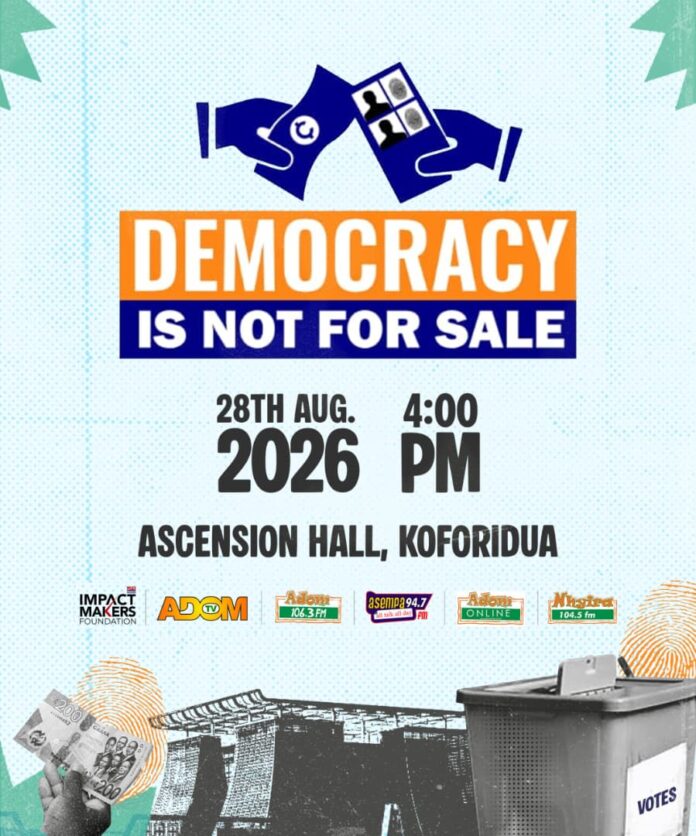

The Eastern Regional capital, Koforidua, will today, Friday, August 28, 2026, host a major public dialogue on the growing influence of money in Ghana’s democratic process.
The forum, dubbed “Democracy Is Not For Sale,” is being organised by Adom Brands of the Multimedia Group Limited in partnership with the JoyNews Impact Makers Foundation.
It is scheduled for 4:00 p.m. at the Ascension Hall in Koforidua.
The engagement will bring together political actors, civil society organisations, traditional leaders, youth groups, community representatives and members of the public to discuss the increasing role of money in Ghanaian politics and its implications for democracy.
Key issues expected to dominate the discussion include vote buying, the rising cost of political participation, campaign financing and the use of illicit funds to influence electoral processes and outcomes.
The forum will also provide citizens with an opportunity to share their experiences and concerns while contributing ideas on how Ghana can strengthen transparency, accountability and fairness in the financing of political activities.
Money and political competition
The growing influence of money has become a major concern in Ghana’s electoral politics, with questions being raised about whether financial power is increasingly determining who gets the opportunity to participate and compete effectively.
The cost of securing party nominations, organising campaigns, mobilising supporters, transporting voters, producing campaign materials and maintaining political structures can be significant.
For individuals without substantial financial resources, these demands can create serious barriers to political participation.
The “Democracy Is Not For Sale” campaign therefore seeks to examine whether the rising cost of politics is gradually changing the nature of democratic competition in Ghana.
Beyond the amount of money spent, participants are expected to examine where campaign funds come from, how they are used, who benefits and whether financial influence can distort voters’ choices.
Vote buying
Vote buying is expected to be one of the key issues under discussion.
The practice of offering money, goods or other inducements to voters in exchange for electoral support has long been a concern among democracy advocates.
Critics argue that such practices can undermine the independence of voters and shift electoral decisions away from policies, competence and the long-term interests of communities.
The concern extends beyond direct cash payments, with campaign-period distribution of food, gifts, transportation and other benefits also raising questions about the extent to which financial inducements have become normalised in electoral competition.
Participants will be encouraged to reflect on the long-term consequences of such practices and how they affect the credibility of Ghana’s elections.
Beyond partisan politics
The organisers say the Koforidua dialogue is intended to go beyond partisan interests and focus on the broader question of the kind of democracy Ghana wants to build.
Discussions are expected to generate practical recommendations on campaign financing, electoral accountability and citizen participation while raising awareness about the risks associated with money politics.
The forum will ultimately challenge stakeholders to consider ways of creating a political environment where candidates can compete based on their ideas, policies, competence and ability to serve the public.
The message of the campaign remains clear: democracy should be a contest of ideas, leadership and vision, not a competition determined by who has the deepest pockets.