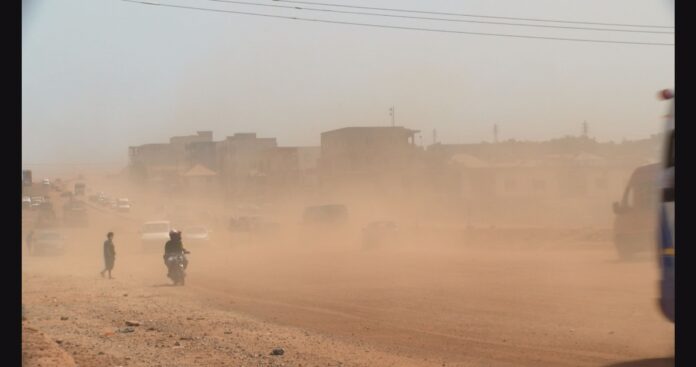

Life for residents and workers along the Adentan–Dodowa Road was upended in 2024. A routine upgrade scheduled to take three long years has left the community covered in dust and harmful pollutants putting thousands of lives here at risk.
The project stalled early on and now experts say the failure to pay the contractor on time has led to delays that may mean this misery continues for the community even longer.
The project is just one of many roadworks under the government’s “Big Push” infrastructure development program across the country that is going on longer than was promised. Delays, often caused by missed government payments to contractors, are leaving millions of Ghanaians exposed to increase risk of deadly diseases linked to air pollution such as asthma, heart disease, cancer and diabetes.
“Here in Ghana we don’t implement engineering projects well, especially government of Ghana-funded projects,” said Joseph Odei, a fellow of the Ghana Institution of Engineers. He said poor oversight, corruption are among the reasons projects are delayed. “They delay paying contractors, so they face challenges and vacate the project.”
The 22-kilometre Adentan–Dodowa dual carriageway stretches from the Adentan Barrier through Katamanso, Oyibi and Gbortsui to the Dodowa Hospital Junction. The project is expected to ease traffic congestion between the Greater Accra, Eastern and Volta regions while improving road safety and reducing travel time. Experts agree it would be a boost to economic activity in the region.
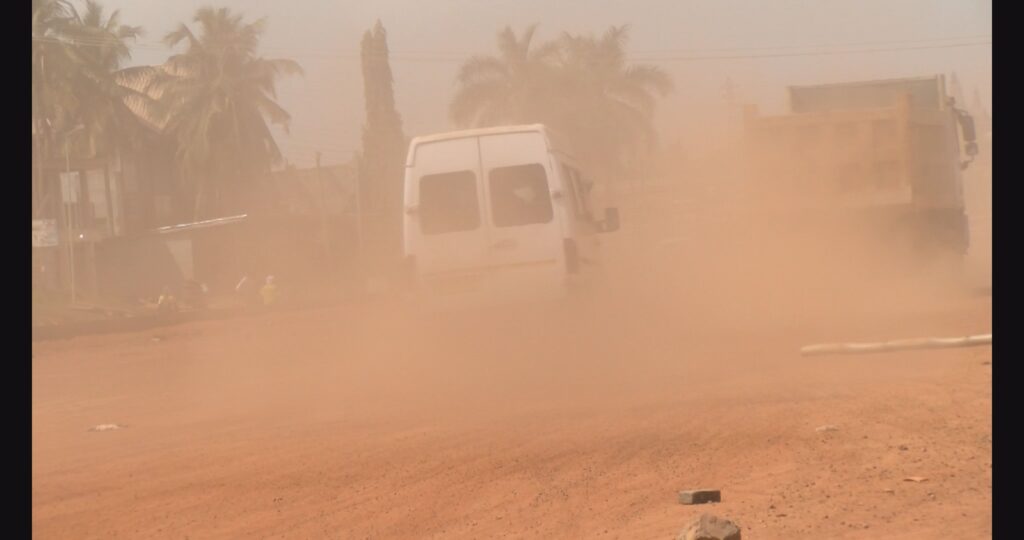
The contract was awarded in March 2024 to experienced Ghanaian company Oswal Investments, under a 36-month agreement. Inspecting the project in a year later, Kwame Agbodza, Minister for Roads and Highways, conceded the project had stalled, blaming the previous government’s failure to make agreed payments. Agbodza said the Mahama government had settled outstanding payments.
Gabriel Foli, project manager for Oswald Investments, declined to comment for this story but in July he told Channel One TV that delays were caused by acquiring property, negotiating compensation for owners, and moving utility lines. But he assured the public the project was two thirds complete and on track to be finished by March 2027.
For residents, the roadworks are taking a heavy toll. People here are well aware of the dangers.
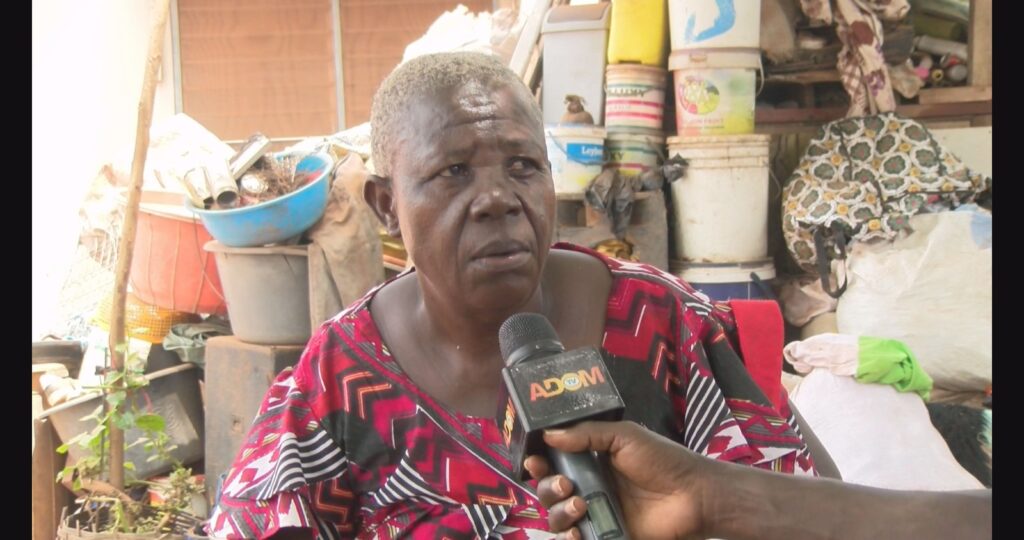
Mary Adjiele, 50, says three of her grandchildren have developed severe coughs accompanied by high fevers since the work began. The family has been forced to spend much of their income on medical treatment at Alpha and Omega Hospital in Dodowa.
“Cough with blood,” Adjile said in Twi. “It is small streaks or drops of bright red blood that come with mucus from three of my grandchildren. The money we use for our business and family upkeep is now going into hospital bills.”
Health experts warn that prolonged exposure to dust particles is dangerous. Fine particulate matter enters the bloodstream, increasing the risk of chronic illnesses, including kidney and heart diseases, diabetes and cancer.
“Road dust often has fine particles, cement, silica, and vehicle exhaust,” said Dorcas Effah Agyeiwaa, a public health nurse at the community’s Amamorley Clinic. “When we breathe it in, it can irritate our airways and make asthma worse. That irritation can cause the blood vessels in the airways to break and lead to blood in the cough.”
Health authorities say the infrastructure development in Ghana is necessary boost to economic activity, but they say the health impacts cannot be ignored and that communities across the country should not be left to deal with the health consequences of delays that were caused by government failures.
The Ghana Health Service reports increasing cases of respiratory illnesses across the Greater Accra Region. According to Dr Robert Amesiya, Greater Accra Regional Director of Health Services, in the two years to 2023, hypertension – a disease closely linked to air pollution – was the fifth highest cause of death in Accra, claiming 200 lives and nearly forty thousand cases were reported. Asthma and cardiac cases also increased.
“We thank government for building the roads for our safety,” said Dr Amesiya in Twi. “But the dust on the construction roads is too much.”
A spare parts dealer operating along the road says the thick dust has made every working day a health challenge. Concerned about his wife’s worsening asthma and persistent coughing, he has asked her to stop assisting him at the shop.
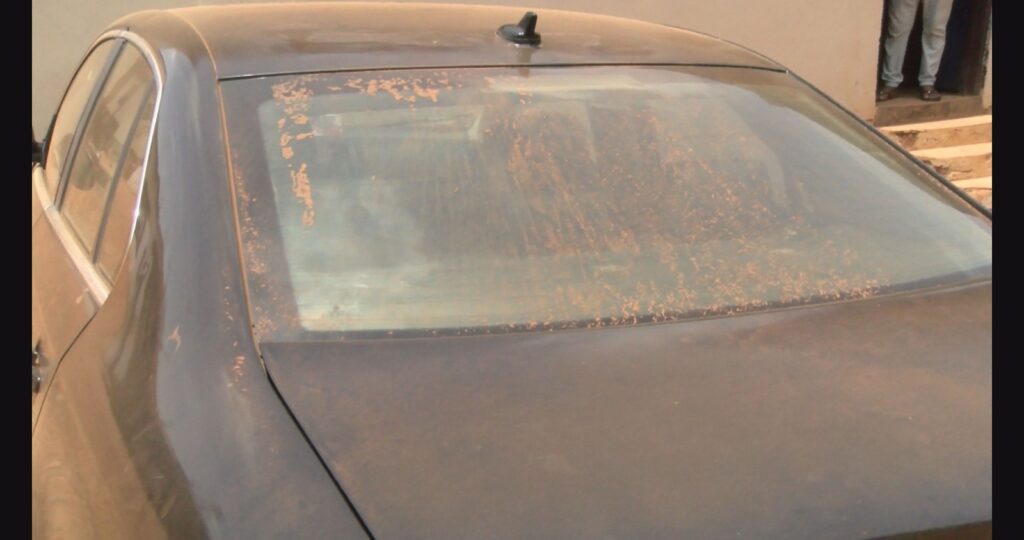
“We sell car parts, but the dust has filled my wife’s and my nose,” the dealer said in Twi. “I clean my shop every twenty minutes, but the dust keeps coming back. My wife has been coughing continuously . We have nowhere else to go because this business is our livelihood. We humbly appeal to the government to asphalt the road to reduce the dust. Our health matters too.”
Provision shop owner Serwaa Ansah Opoku says the dust has left her battling constant illness.
“Because of the dust on the road, when we wear our clothes it turns brown,” she said in Twi. “We keep getting headaches. We take local herbal medicine and the drugs our doctors prescribed for us to take care of the headaches and blood pressure.”
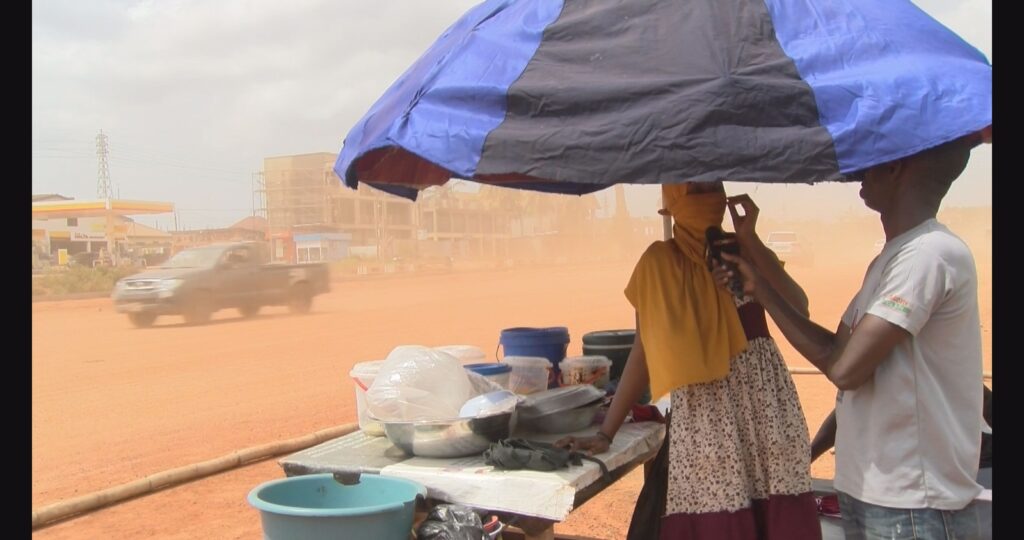
While waakye vendor Hamdia Ishmahill, a student, reports frequent coughs that have affected her business.
“It worries me. The dust has reduced our customers who buy waakye from us,” the student said in Twi. “My mum is not able to come to the wayside to sell. I’m a student so I normally come to support her. I always get coughs. But because people complain there is no food around, I’m forced to sell in the dust.”
Traditional leaders are equally worried. Chief Adjie Kwashie, Linguist of the Adenta Frafraha, said asthma cases within the community are increasing, with many residents complaining of worsening respiratory conditions. The traditional palace has been suspended because of the unhealthy environment.
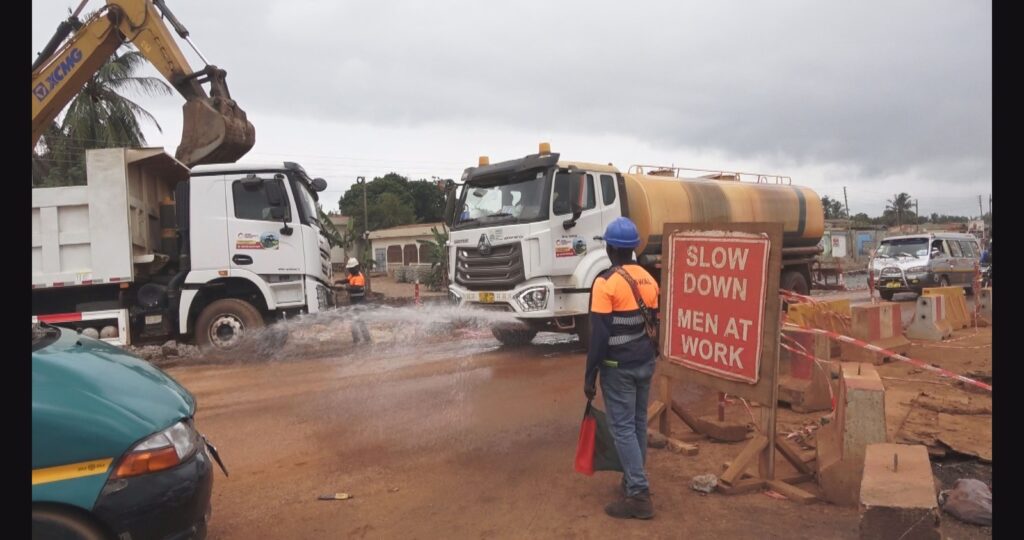
“We have elderly people who come to our palace reporting cases of asthma,” said Chief Kwashie, in Twi. “We’ve asked them to tell the contractor to continue watering the road to reduce the dust. We’ve also reached out to the workers constructing the road. Once in a while they come to sprinkle water on the road. We need asphalt on our road.”
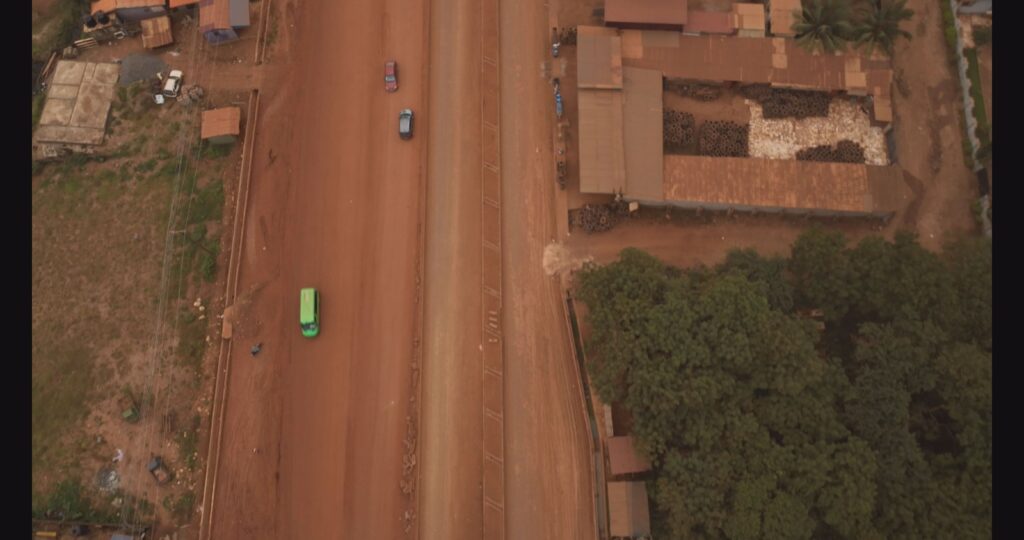
In his April 2026 visit the Minister directed the contractor to regularly sprinkle water on the road to minimise dust and reduce its impact on surrounding communities, stressing that protecting residents’ health remains a responsibility of the contractor.
“We expect a lot more speed,” Minister Agbodza said in Twi, speaking with engineers and the contractor. “This is another very important corridor which, when completed, will help significantly. So pay attention to it. While you are doing it, the dust will be to the minimum. We know it is difficult. We know it’s not easy to water continuously, but that is your responsibility, so don’t run away from it.”
Ella Christine Esinam Nongo, Municipal Chief Executive for Adentan, has assured residents that the Assembly and the contractor are working together to reduce dust pollution.
“Residents, please be a little patient with us,” an assembly official said in Twi. “If the contractors come to fix it and there are still potholes, the same people will not be happy with us. We beg you. Since we have endured bad roads for a long time, give us a little time to fix it. Anytime the contractor is not around, the Assembly sprinkles water on the road.”
Dr Amesiya urged residents to wear nose masks to minimize exposure to dust while efforts continue to control pollution along the construction corridor.
This story is a collaboration with New Narratives as part of the Clean Air Reporting project. Funding was provided by the Clean Air Fund which had no say in the story’s content.