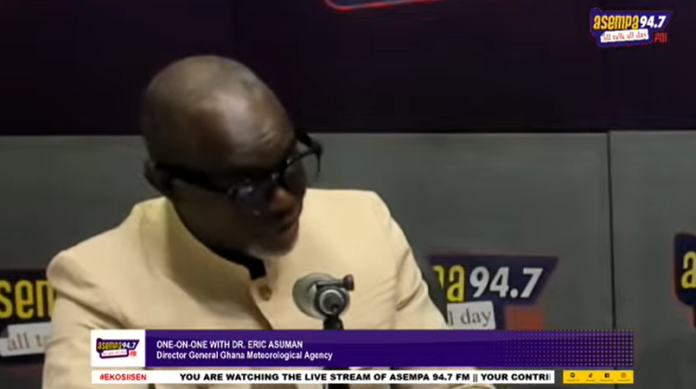

The Director-General of the Ghana Meteorological Agency (GMet), Dr Eric Asuman, has clarified that the agency does not receive or manage funds under the Greater Accra Resilient and Integrated Development (GARID) project, stressing that its role is purely technical.
Speaking in an interview, Dr Asuman said GMet only provides technical input while the GARID Secretariat manages project financing and implementation.
“GMet doesn’t have any account, doesn’t receive any money under GARID. We are just partners telling them what we want,” he said on Asempa FM’s Ekosii Sen show.
He explained that under the project, GARID has procured equipment for rainfall measurement and developed software systems to integrate data between GMet and the Ghana Hydrological Authority to improve flood forecasting.
“GARID has procured a reader for us to determine the volume of rainfall. They have also developed a software to integrate GMet data and the Hydrological Authority,” he noted.
According to him, while GMet is responsible for forecasting rainfall, the Hydrological Authority handles flood modelling, with the National Disaster Management Organisation (NADMO) using the data to identify flood-prone areas and coordinate response efforts.
“To forecast rainfall is our job. Determining floods is the Hydrological Authority’s work. NADMO then uses that information to identify flood-prone areas and respond,” he explained.
Dr Asuman said the Accra Flood Early Warning System (FEWS) project under GARID is designed to strengthen coordination among agencies, but has faced delays in implementation.
He disclosed that funding challenges had slowed progress, particularly in the construction of infrastructure needed for the installation of equipment.
“There were some delays in the release of funds. When we said we were going to build the stand for the reader, the Works and Housing Ministry showed us a design they had prepared. It was delaying,” he said.
He added that GMet had even considered constructing the infrastructure itself to avoid further delays before the recent floods occurred.
“We wanted to do the stand ourselves, then the disaster happened,” he noted.
Dr Asuman said he had since proposed repurposing part of the project support to ensure continuity of operations, including securing solar power for uninterrupted services.
“I suggested we could use the opportunity to complete it and repurpose some support for solar to ensure uninterrupted power supply for our office,” he said.
“The project is World Bank funded. GMet doesn’t handle the money. The GARID Secretariat has direct access to the funding,” he explained.
Despite delays, he maintained that the Flood Early Warning System project remains ongoing and is expected to improve forecasting accuracy once fully implemented.
“If we get all the equipment, we will be able to forecast the weather more accurately,” he added.
Accra Flood Early Warning System (FEWS-Accra) is a $7 million initiative under the Greater Accra Resilience and Integrated Development (GARID) Project. Financed by the World Bank and led by the Ministry of Works and Housing, it aims to proactively forecast floods and disseminate actionable warnings to residents in high-risk areas.
READ ALSO:
GMet to launch mobile weather alert app by end of 2026
Government made efforts to prepare for floods – GMet Director-General