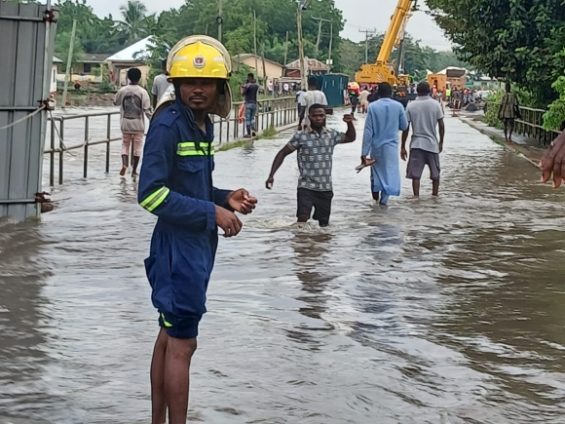

Operational Governance and Risk Management Expert, ED Andrews, has called for a long-term and continuous approach to flood mitigation in Accra, warning that disaster management in Ghana remains too focused on response instead of prevention and preparedness.
Speaking on JoyNews’ Newsfile on Saturday, July 4, during a discussion on the recurring floods in Accra, Mr Andrews said the country’s handling of flood disasters continues to expose serious weaknesses in planning, rescue preparedness and long-term mitigation.
According to him, disaster management should not begin only after floodwaters have destroyed homes, displaced residents, and claimed lives.
“What I want to clearly put across is that disaster management is not about response. That is what we are seeing,” he said.
“Disaster management itself is a cycle which starts with mitigation. Then we go into preparedness.”
Mr Andrews explained that preparedness goes far beyond emergency reaction after a disaster has happened. In his view, it should include practical planning, simulations, and rescue drills so that institutions know how to respond effectively when lives are at risk.
“Preparedness is not just about response. Preparedness is even simulating how we save people.”
He said that Ghana should not be caught off guard by severe flooding because the country’s own rainfall data suggests a pattern that points to recurring high-impact events over time.
Citing historical rainfall figures, Mr Andrews said there appears to be a cycle of major rainfall events roughly every 10 years, making the threat of devastating floods largely predictable.
“The data points to some cycles of event, and it’s like a 10-year cycle,” he said.
“So if we go back to 1990, we take it from 1990 up to 2026, like every 10 years, we experience some volume of rainfall on this scale every 10 years. So it’s a cycle.”
He said this pattern means state agencies and disaster planners should have been far better prepared for the latest floods.
“So the predictability, from a risk management point of view, is there,” he stated. “Our level of preparedness and how we dealt with the situation shouldn’t have been what it is.”
To support his point, Mr Andrews referred to recent rainfall figures, including 243.9mm in one hour on July 3, 212.8mm on June 3, 182.5mm on June 9, and 169.2mm on June 29, 2026, saying these events show the scale of the threat Accra faces.
“So almost every 10 years, some event of this nature happens. So the predictability is there,” he said.
Mr Andrews said that his criticism was not based on complicated scientific forecasting or sophisticated weather technology, but on basic data that should already be available to those responsible for planning.
“This one, I’m not even being scientific. I’m not talking about early warning systems. I’m just looking at pure data for those who plan for these things to have worked with,” he said.
He said the country had failed to prepare for a mass casualty event, adding that there appeared to be no evidence of practical rescue simulations or coordinated flood response exercises involving key state institutions.
“So we didn’t prepare for a mass casualty event. How would we rescue people? There are no simulations,” he said.
Mr Andrews said that he had reviewed available literature and tried to establish whether the National Disaster Management Organisation (NADMO) works with the military or other agencies to carry out flood response practice exercises, but found no evidence of such preparation.
“I’ve tried to find out whether we do any practices, whether NADMO engages in this type of activity in conjunction with the military to help deal with this situation. It doesn’t exist. So that is the preparedness element. We don’t have it.”
He described the situation as a “massive failure”, saying the absence of proper preparedness has left the country vulnerable whenever heavy rains trigger major flooding.
Beyond preparedness, Mr Andrews also turned attention to mitigation, particularly the work being done under the Greater Accra Resilient and Integrated Development (GARID) project. He acknowledged that the project contains strong ideas and could make a meaningful difference if fully implemented.
“When we come to the mitigation element, which we’ve dealt with through GARID, reading about what GARID intends to do, it is fantastic, if you look at the detail of what it wants to do,” he said. “And if it succeeds, it should lead to flood reduction.”