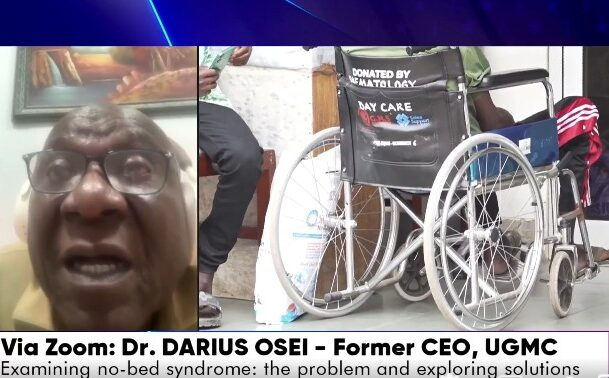

The former Chief Executive Officer of the University of Ghana Medical Centre (UGMC), Dr Darius Osei, has revealed how he watched helplessly as his niece died due to critical gaps in Ghana’s emergency care system.
Speaking during a high-stakes JoyNews dialogue on national emergency care delivery on Thursday, April 2, 2026, Dr Osei described the painful reality of a healthcare system where even top medical administrators are not insulated from systemic failures.
He recounted the final moments of his niece, a university student, whose life was lost despite being under medical supervision at a hospital.
According to him, the situation unfolded over a chaotic four-hour period in the emergency ward, where his expertise could not save his relative, who had been rushed to another facility.
“I realised, and I lost a patient, that is my niece, who was in the university,” Dr Osei said, visibly emotional. “I stood by her in the emergency; we spent four hours. I was sent to go to the lab to bring the bottle, and I brought it and then, you know, up and down. And so finally, I lost my niece.”
His account highlights a recurring challenge in Ghana’s healthcare system, where relatives are often required to move between departments to procure basic items such as laboratory consumables while patients remain in critical condition.
The incident underscores deep concerns about existing emergency care protocols.
Dr Osei noted that if someone of his background could be reduced to running errands while his niece’s life slipped away, it raises serious concerns about the experiences of ordinary citizens without similar access or influence.
The “up and down” movement he described reflects the fragmented nature of emergency care delivery, where families must secure hospital cards, folders, medication, and make upfront payments before treatment is fully administered.
His testimony aligns with growing calls from emergency care specialists for the adoption of a “one-stop-shop” emergency model.
Under this system, essential services—including laboratory testing, imaging, and pharmacy—would be integrated within the emergency unit to eliminate delays that can prove fatal during the critical “golden hour.”
Dr Osei also renewed his call for the removal of upfront payment requirements in emergency situations, stressing that saving lives must take precedence over financial processes.