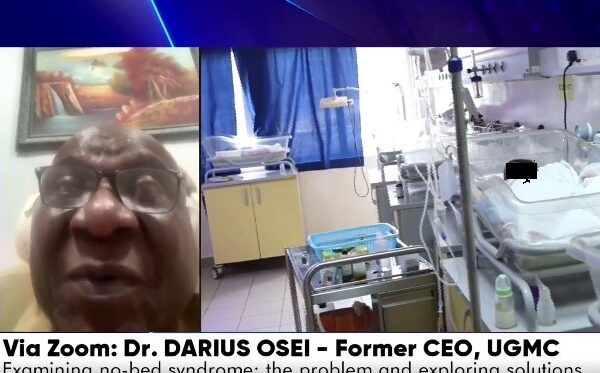

The former Chief Executive Officer of the University of Ghana Medical Centre (UGMC), Dr Darius Osei, has criticised the “pay-before-service” culture in Ghana’s emergency wards, describing the practice of demanding money from trauma victims as a “death sentence.”
Speaking during a high-profile JoyNews dialogue on Thursday, April 2, 2026, Dr Osei argued that the current system—where Good Samaritans and relatives are forced to navigate multiple payment points while a patient’s life hangs in the balance—undermines basic medical ethics.
Drawing from his tenure at UGMC, he outlined a reform model he implemented at the facility, advocating for a nationwide policy where no payments are required from emergency patients within the first 24 hours of arrival.
“There was a policy that no money should be collected from any patient within 24 hours. Patients must be attended to within 10 minutes,” Dr Osei stated. “It is so cumbersome going around with documentation, getting payments done and so forth. Nobody carries 20,000 or 10,000 in their pocket… By the time they finish, the patient is dead.”
The “one-stop-shop” emergency unit model
Dr Osei emphasised that an emergency unit is only as effective as its proximity to critical diagnostic services. He explained that during his time at UGMC, pharmacy, laboratory and radiology units were strategically integrated within the emergency centre to eliminate delays caused by moving patients and relatives across different parts of the hospital.
“That is the reason why it is called an emergency,” he noted, stressing that effective emergency care requires immediate access to medication and diagnostic tools at the point of care.
Beyond the billing challenges, Dr Osei also highlighted what he described as a “technical vacuum” in many district hospitals.
He noted that although the Ghana College of Physicians and Surgeons continues to produce highly skilled specialists, many remain concentrated in Accra due to the lack of essential diagnostic equipment in regional and district facilities.
“I believe that if for nothing at all, each district hospital should have a CT scan,” he said. “We don’t have standards. Let’s standardise our operations… these days, imaging has become part of our diagnostic tools because students have been trained with these tools and that is all they know.”
A call for national standardisation
Dr Osei concluded by calling for a comprehensive overhaul of Ghana’s emergency care system. He urged the adoption of a “Care First, Pay Later” legal framework, alongside the standardisation of equipment and protocols across all health facilities.
He warned that without such reforms, the country risks continuing to lose lives to delays that are both predictable and preventable.
As discussions around “No-Bed” and “No-Money” policies intensify, Dr Osei’s remarks present a practical administrative model that prioritises patient care over financial procedures.