
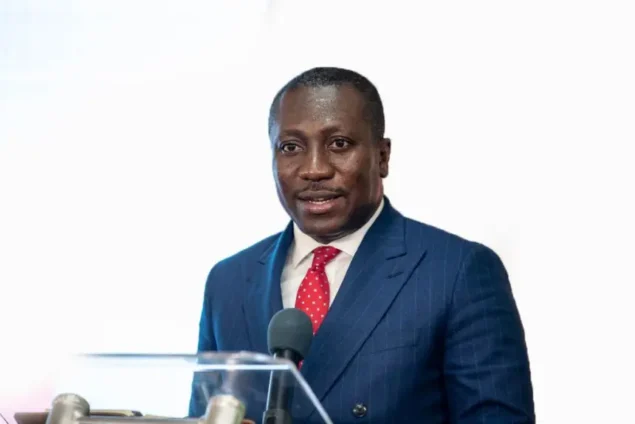

The Minority Leader in Parliament, Alexander Afenyo-Markin, has criticised government-linked contractors, accusing them of sabotaging Ghana’s agricultural backbone by importing rice in defiance of presidential directives.
Addressing the Kwahu Business Forum on Friday, April 3, 2026, the Minority Leader described the sidelining of local farmers as a calculated subversion of national food security goals. He argued that while the state has publicly championed the “Buying Ghana” agenda, the reality reflects a systemic preference for imported grains, leaving local warehouses with unsold produce.
The controversy centres on the School Feeding Programme, a multi-million-cedi initiative intended to provide a guaranteed market for Ghanaian rice growers.
However, according to Mr Afenyo-Markin, contractors awarded supply deals are bypassing local silos in favour of cheaper imported alternatives.
“Contractors engaged to supply the School Feeding Programme with locally produced rice are bypassing farmers who had prepared their produce following a direct presidential directive,” he stated.
He noted that the situation has had a severe impact on the rice value chain, with many farmers—who had ramped up production in anticipation of ready markets—now facing mounting debts and post-harvest losses.
Mr Afenyo-Markin further criticised the lack of transparency at the National Food Buffer Stock Company (NAFCO), revealing that despite repeated petitions from agricultural groups, the identities of contractors involved remain undisclosed.
“The Peasant Farmers Association of Ghana has repeatedly requested that NAFCO publish the names of those contractors. NAFCO has not responded,” he said, adding: “What has been described is not a market failure. It is a procurement betrayal.”
The Minority Caucus has signalled plans to pursue a parliamentary inquiry aimed at compelling the release of all active supply contracts and identifying beneficiaries involved in the procurement process.
Mr Afenyo-Markin warned that such lapses not only undermine the economy but also erode trust between the state and rural communities.
Without immediate reforms to ensure that state-backed programmes genuinely support local producers, he cautioned that Ghana’s drive toward self-sufficiency will remain elusive.
“Let us choose accountability over secrecy,” he concluded, urging government to align its procurement practices with its stated commitment to protecting the livelihoods of local farmers.