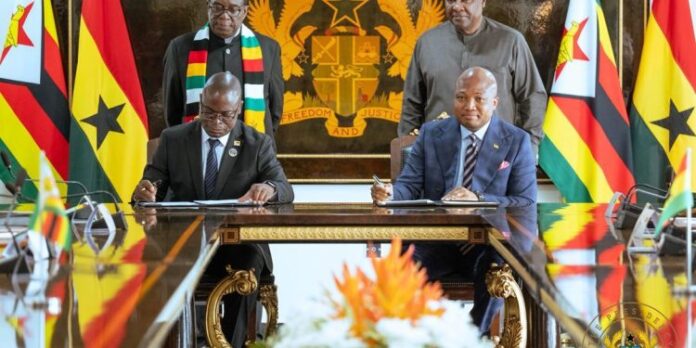

Ghana and Zimbabwe have signed 11 Memoranda of Understanding (MoUs) aimed at strengthening collaboration across several sectors, following the state visit of President Emmerson Mnangagwa.
The agreements, concluded during high-level bilateral engagements, cover key areas including diplomacy, health, energy, tourism, sports, and trade, as both countries seek to deepen ties and promote regional integration.
Officials say the MoUs are expected to drive knowledge exchange, joint research, infrastructure development, and expanded economic cooperation.
Among the notable agreements is a partnership between the Institute of African Knowledge and the Ghana Museums and Monuments Board, focusing on African liberation projects. Another deal was signed between ZimTrade and the Ghana Export Promotion Authority (GEPA) to enhance trade relations.
In addition, a private sector agreement was reached between Zoomlion Ghana Limited and Geo Pomona Waste Management (Pvt) Ltd, signalling growing collaboration in waste management and environmental services.
The agreements span a wide range of cooperation areas, including MoU on Cooperation in Political and Diplomatic Consultations, MoU on Research, Training and Documentation in Foreign Services Institutes between the two countries, MoU on Cooperation in the field of Sports and Recreation Development, MoU on Cooperation in the field of Health, MoU on Cooperation in the field of Energy and MoU on Cooperation in the field of Archives.
The rest are MoU on Cooperation in the field of Tourism, MoU between ZIM-Trade and the Ghana Export Promotion Authority (GEPA), MoU between the Institute of African Knowledge and the Ghana Museum and Monument Board in collaboration in African liberation project MoU with Zoomlion Ghana Limited and Geo Pomona Waste Management (Pvt) Ltd.
The agreements are expected to complement Ghana’s broader push to position itself as a hub for Pan-African trade and tourism, while strengthening long-term bilateral relations between the two countries.
President John Dramani Mahama has previously indicated that such partnerships are critical to advancing Africa’s development agenda through cooperation and shared growth.
ALSO READ: