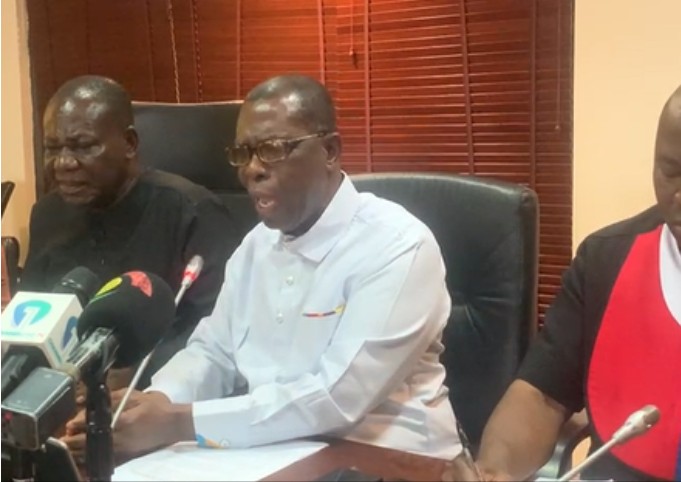

The Member of Parliament for Offinso, Dr Isaac Opoku, has blamed the current administration for the difficulties confronting Ghana’s cocoa sector, insisting that responsibility for the situation cannot be shifted elsewhere.
According to the Ranking Member on Parliament’s Food, Agriculture and Cocoa Affairs Committee, key economic decisions taken by the present government, particularly in relation to exchange rate management, have directly affected cocoa operations and payments to farmers.
“You can blame the administration. You can put the challenges at the doorstep of the current administration,” Dr Opoku said, questioning, “The current exchange rates we are seeing, who caused them?”
He argued that cocoa farmers were paid at exchange rates set by the current government, making it untenable to attribute the problems to previous administrations.
“When they were paying the cocoa farmer in January, February, March, up to October, what was the exchange rate?” he asked.
“They cannot put the blame anywhere else apart from the current administration.”
Dr Opoku also called on the Ghana Cocoa Board to be more open with farmers about the true nature of the challenges facing the sector.
“They should come clear. They should tell the cocoa farmer what the real problem is and stop beating about the bush,” he stated.
He further suggested that the impact of the current difficulties would have been far more severe if not for actions taken by the previous administration, particularly the decision to trade some cocoa forward.
“In fact, they are even lucky that the previous administration traded some cocoa forward. Otherwise, the situation would have been worse than what we are seeing today,” he said.
Addressing public debate over cocoa contract rollovers, the Offinso MP dismissed claims that the practice is unusual, describing it as a normal feature of the global cocoa trade.
“You do your projections. If you anticipate producing a certain quantity and, for some reason, you are unable to meet that target, you roll over the contracts at the prevailing price. It happens all the time,” he explained.
He recalled that when the Nana Addo-led government assumed office in 2017, it inherited cocoa contract rollovers amounting to about 190,208 tonnes without attracting similar public criticism.
He also cited Côte d’Ivoire’s rollover of about 500,000 metric tonnes in 2024 as further proof that the practice is common.
“Contract rollovers are standard industry practice. It happens all the time,” Dr Opoku emphasised, warning that unforeseen events could still disrupt current production projections and lead to further rollovers.