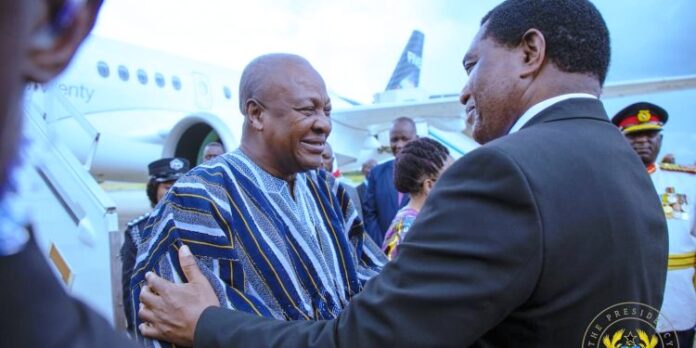

President of Zambia, Hakainde Hichilema, jokingly announced that his country would be placing orders for more Ghanaian fugu, following days of animated social media exchanges sparked by President John Dramani Mahama’s attire during his state visit to Zambia.
The Zambian leader made the light-hearted remark at the Ghana–Zambia Business Forum on Friday, February 6, 2026, as President Mahama continues a three-day visit aimed at strengthening bilateral relations.
While the visit has featured high-level diplomatic and economic engagements, public attention quickly shifted to President Mahama’s choice of outfit. The Ghanaian leader has been seen wearing the fugu — a traditional smock associated with northern Ghanaian culture and heritage.
The attire, which symbolizes identity, pride, and cultural expression, generated mixed reactions online. Many Ghanaians applauded the president for promoting local culture on an international stage, while some Zambian social media users referred to it as a “blouse,” sparking playful exchanges between the countries’ netizens.
Addressing the matter with humor, President Hichilema embraced the cultural moment.
“I am very happy that the foreign minister is wearing that,” he said, referring to Ghana’s Minister for Foreign Affairs, Samuel Okudzeto Ablakwa. “I have asked my team to post on various platforms that the president of Zambia will be ordering more of that for himself.”
Responding to the remarks, Mr. Ablakwa said the conversation had grown beyond fashion, sparking a wider reflection on African identity and culture.
“This is my president’s favourite attire, the fugu,” he said. “We are excited about the buzz it has generated. It has triggered a renaissance in what Kwame Nkrumah described as the African personality.”
He added that the discussion highlights deeper issues of identity and self-worth on the continent.
“That is about reclaiming African identity, dignity, and culture. When we talk about restitution and reparation, it is not only about compensation for the transatlantic slave trade; it is also about reconnecting with our roots and identity,” the Foreign Minister explained.
What began as online banter has now evolved into a light-hearted cultural exchange, allowing both countries to celebrate Africa’s rich diversity and shared heritage.