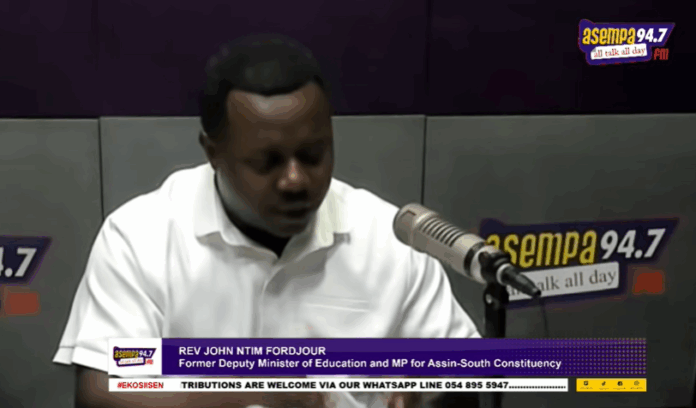

Former Deputy Minister of Education and Member of Parliament for Assin South, Rev. John Ntim Fordjour, has called on the Minister of Education to appear before Parliament to address concerns over a controversial definition of gender identity in the Senior High School Physical Education and Health (PH&E) teachers’ manual.
Speaking on Asempa FM’s Ekosii Sen show, Rev. Fordjour described the content as dangerous and accused the National Council for Curriculum and Assessment (NaCCA) of breaching public trust by allowing the material to be printed and circulated.
“You cannot trust NaCCA again. They breached the trust Ghanaians had in them by allowing this to come out. They printed the books themselves when their mandate is to review before printing. This is a deliberate, systematic attempt, and it is dangerous,” he said.
Rev. Fordjour insisted the issue goes beyond politics, highlighting concerns about the credibility and moral direction of Ghana’s education system. He claimed that if the controversy had not been exposed, the definition would not have been revised, and he noted that other definitions in the manual also pose challenges.
He called for the immediate recall of all hard copies of the manual, deletion of digital versions, and a clear directive to schools and regional education directors. He also urged NaCCA to convene a stakeholder meeting to agree on definitions that align with Ghanaian culture and moral values before reprinting.
“The Minister of Education needs to come to Parliament to answer on this matter and give assurances that this will not happen again,” he added.
Meanwhile, in a press release dated January 13, 2026, NaCCA acknowledged that the definition of “gender identity” in the Year Two PH&E (Elective) Teacher Manual does not reflect Ghanaian culture, norms, and values. The Council stressed that the national curriculum itself does not include such content.
According to the manual, gender identity was defined as a person’s deeply felt internal experience of gender, which may or may not correspond with the sex assigned at birth, and may include being male, female, or a blend of both.
READ ALSO: