
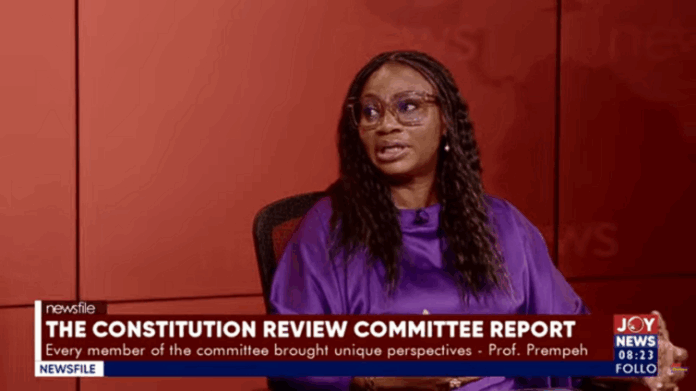

Lawyer and former Chairperson of the Electoral Commission and the National Commission for Civic Education (NCCE), Charlotte Kesson-Smith Osei, has described her participation in the Constitution Review Committee (CRC) process as “a privilege of a lifetime”.
Speaking on Newsfile on JoyNews, Ms Osei reflected on the experience of serving on the CRC, just days after the committee submitted its summary report to President John Dramani Mahama.
The report, presented on Monday, December 22, represents a significant milestone in Ghana’s constitutional reform journey. The final report will be made available in January.
The CRC’s recommendations include major proposed changes such as the separation of the legislature from the executive, a clear reaffirmation that the constitution does not allow for a third presidential term, and a proposal to extend the presidential term of office from four to five years.
Focusing on the human and intellectual process behind the report, Ms Osei said the committee was comprised of individuals from widely diverse backgrounds, creating a rich environment for debate and learning.
“I think it was a privilege of a lifetime,” she said. “We had people from very different backgrounds. Even the lawyers among us had very different kinds of experiences that they brought on board.”
According to her, what made the process exceptional was the willingness of members to listen to one another, even when they held strongly opposing views.
She noted that the committee included distinct ideological camps, including those she described as “abolitionists”, who favoured sweeping changes to the constitutional order.
“We had camps – the abolitionists – and at one time you would see how one view influenced the other view,” she explained. “Some of the champion abolitionists became the reformers.”
Ms Osei stressed that disagreements were handled openly and respectfully, without undermining the sense of unity within the group.
She described an atmosphere of kinship and authenticity, where members felt safe to express dissenting opinions.
“Everyone was allowed to express their view. If we disagreed, we would tell you, ‘This one we don’t agree,’” she said. “But we were friends, family, and everyone supported each other.”
She also drew attention to the deliberate efforts made to ensure that all members, regardless of their professional background, could engage fully with the complex constitutional issues under discussion.
She noted that lawyers on the committee took time to support non-lawyers who found some concepts challenging.
“You would have maybe a non-lawyer who is struggling with understanding some constitutional concepts, and we arranged classes among ourselves to help people understand those things,” she revealed.
ALSO READ:
