
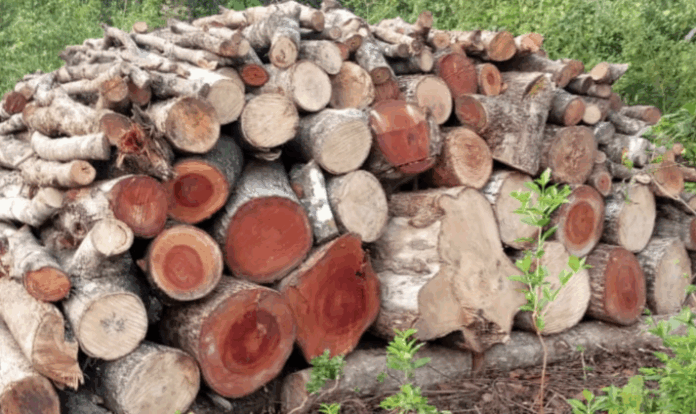

A Ghana News Agency (GNA) investigation has uncovered extensive illegal farming and charcoal production within the Chai River Forest Reserve in the Krachi East and Nkwanta South municipalities of the Oti Region, with forestry officials allegedly ignoring the destruction.
Despite the routine presence of forestry personnel, the reserve faces a growing environmental crisis marked by deforestation and land degradation.
The year-long investigation revealed that large tracts of forest land have been cleared for farming without permits. Trees have been burned without replanting, causing significant ecological damage.
Using Ghana Post GPS number OS-06248-2925, GNA identified more than 26 individual farms within pillar 200 near the Tutukpene community under Nkwanta South. These farms, featuring yam mounds and cassava from previous and current seasons, have contributed to extensive deforestation.
In Compartment 108, under the Kpelema community (GPS: OE-2923-4276), GNA also identified active charcoal-burning sites. Another site was observed at OE-02356-5786 within the reserve under the Kparekpare community.
Further investigations revealed numerous yam mounds scattered across the forest, underscoring how individuals have exploited weak enforcement by forestry authorities.
Traditional Authorities Alarmed
Nana Foster Atta Owusu III, Chief of Kparekpare, expressed deep concern over the ongoing illegal farming and logging activities.
In an exclusive interview, he said repeated reports to forestry officials had yielded no action.
“As traditional authorities, we are deeply pained watching the destruction of this reserve. Despite numerous reports, officials have ignored and neglected the situation, allowing people to invade and exploit the forest,” he lamented.
Nana Owusu III has therefore, called on the government, the Forestry Commission, the Oti Regional Minister, and the Municipal Chief Executives of Nkwanta South and Krachi East to take immediate action to protect the Chai River Forest Reserve.
Allegations Against Forestry Officer
Meanwhile, farmers operating within the reserve have allegedly implicated a forest officer, Mr Adjei Akwasi Adomako, in activities contributing to the destruction.
They claimed Mr Adomako granted them access to cultivate portions of the protected forest, advising them to plant trees alongside crops as a condition for entry.
Mr Kakrah Fio, a resident of Kparekpare, corroborated these accounts, stating that the officer permitted farming but directed that tree planting should accompany the activities.
When contacted, Mr Adomako—now transferred to Nkwanta South—denied authorising illegal farming. He explained that he distributed seedlings to some farmers and instructed them to nurture the trees to prevent bushfires and restore degraded portions of the reserve.
However, GNA investigations found that several farms within the reserve have existed for three to four years, raising questions about how such activities persisted in a protected area.
Observations further showed that only a small section of the reserve had evidence of thickly planted trees, suggesting limited compliance and weak enforcement.
Accountability Concerns
The findings have reignited concerns about the effectiveness of supervision and accountability in managing the Chai River Forest Reserve.
Mr Bernard Tabil, Oti Regional Forestry Manager, avoided answering questions on the widespread deforestation. When contacted on Sunday, December 21, he questioned whether journalists work on weekends and later declined agreed follow-up calls.
Mr Safo Nketia, Municipal Chief Executive (MCE) of Krachi East, expressed frustration over the ongoing deforestation despite his efforts to address the issue.
After GNA approached him, he invited the Municipal Forest Manager to provide insight and engage with the investigator, but his advice and efforts were ignored.
ALSO READ:
