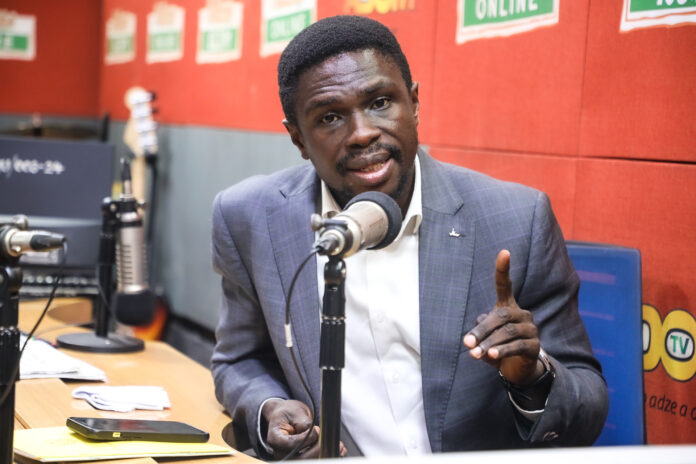

Investigative journalist Manasseh Azure Awuni has pushed back strongly against remarks by the Office of the Special Prosecutor (OSP)’s Director of Strategy, Research and Communications, Samuel Appiah Darko, describing them as an indictment of the OSP’s own handling of the AB Adjei corruption case.
Mr. Darko, responding to a Facebook post on December 2, 2025, claimed that “it is a fact that since the investigative journalist published his work, the trial is only now beginning.”
But Manasseh says that assertion is false.
He explained that he had already testified during the first trial and had been cross-examined from December 2022 to April 2024. According to him, “the trial could not only be starting in December 2024,” stressing that proceedings began as far back as 2022.
Mr. Darko also argued that investigative journalism merely “provides a spark,” insisting that what journalists uncover “is not, in itself, evidence.” He said criminal investigators must scrutinise the material, corroborate it, gather original documents, and turn it into admissible evidence.
He further claimed that investigators at the OSP initially relied on the journalist’s findings to proceed to court, but after review, the case was found “hollow and lacking strong evidentiary support,” prompting a re-investigation that included financial inquiries and document authentication.
Manasseh questioned that explanation, pointing out that the charge sheet was signed by the Special Prosecutor, Kissi Agyebeng, and not by investigators. “So, one wonders why Sammy Darko said it was the investigators who proceeded to court, and the prosecutors later reviewed the case,” he said.
He described Mr. Darko’s own words as the true indictment, noting that the OSP spokesperson first downplayed investigative journalism as merely a “spark” yet simultaneously claimed the Office relied solely on his work to initiate prosecution.
Manasseh said it was troubling that the OSP spent nearly two years prosecuting the case “before realising that it was hollow.”
He further raised concerns about omissions in the OSP’s filings, pointing out that despite claiming reliance on the journalist’s findings, the Office still failed to submit the key evidence — the audio-visual documentary — when the case was taken to court.