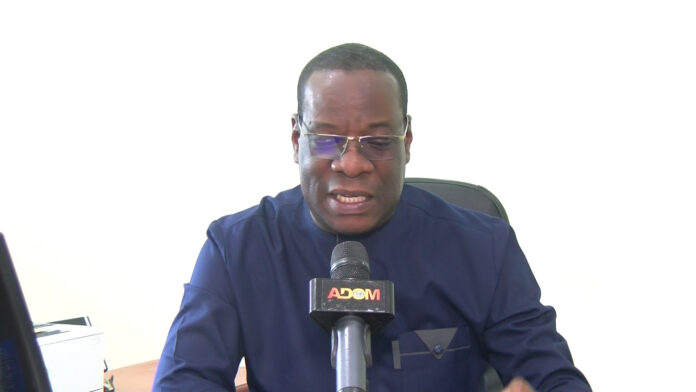

The Head of Public Relations at the West African Examinations Council (WAEC), John Kapi, has raised alarm over the increasing use of pidgin and social media expressions in students’ WASSCE scripts, describing the trend as a major threat to performance in English.
Speaking in an interview on Channel One TV, he revealed that the Chief Examiner’s report for the 2025 English paper highlighted widespread use of informal language, including slang, shorthand, and WhatsApp-style writing.
Markers detected “a lot of pidgin” in candidates’ essays, alongside casual expressions that “have no place in a formal examination setting,” he said, stressing that reliance on social media language is eroding students’ ability to communicate effectively in standard English.
“If you look at the English report, for example, the Chief Examiner indicated there was a lot of pidgin in what the candidates wrote. They also referred to what they called ‘social media language’ — jargons we normally use on WhatsApp, which are not formal,” he noted.
Mr. Kapi further highlighted that beyond inappropriate language, many students struggled with basic spelling and sentence construction, reflecting broader challenges within homes, schools, and society.
“Especially in the English paper, some candidates could not use standard language, could not spell properly, and could not construct appropriate sentences for their essays,” he said.
He called for a coordinated response from parents, teachers, and education authorities to reinforce proper language use from early childhood.
“We need to address this from home, from where the children grow up, and also examine whether the school system has enough support structures to help students learn. As a society, there is much to do to put our children in a position to learn well,” he added.
His concerns come as WASSCE results show one of the steepest declines in performance in recent years. A1–C6 passes in Core Mathematics dropped from 305,132 in 2024 to 209,068 in 2025 — a fall of over 96,000 candidates, translating to a pass rate of just 48.73%.
Further analysis reveals that nearly one in four students failed both Core Mathematics and Social Studies, pointing to deep-rooted academic challenges beyond language proficiency.