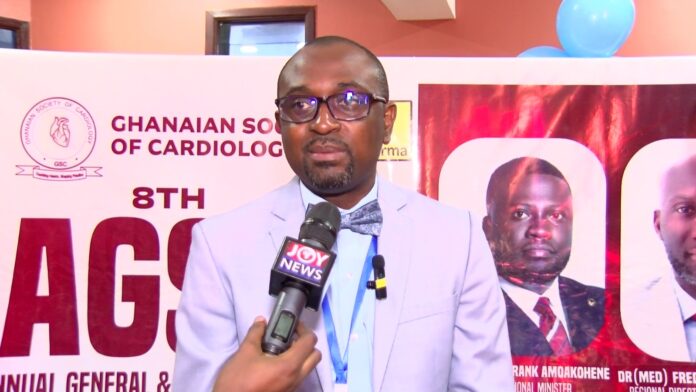

The Ghanaian Society of Cardiology has raised alarm over the continuous rise in heart failure cases reported at health facilities across the country.
Latest statistics from studies conducted by the Society show that eight out of 10 cardiac hospitalisation cases recorded at the Komfo Anokye Teaching Hospital (KATH) in Kumasi are attributable to heart failure.
The worrying trend is primarily driven by uncontrolled hypertension, compounded by limited diagnostic tools, a doctor-to-patient ratio estimated at one million patients to one doctor in some areas, and the late presentation of cases at hospitals.

Heart failure remains one of the most pressing cardiovascular challenges in Africa, with Ghana recording daily cases. It is a leading cause of death among adults in the country, with the average age of patients estimated between 40 and 50 years.
A single-centre study at KATH further revealed that 88 percent of cases admitted at the cardiothoracic department were heart failure-related.
“Uncontrolled hypertension remains the leading underlying cause of heart failure in Ghana, alongside poorly managed diabetes and high cholesterol levels. Heart attacks, caused by blocked blood flow to the heart, are also contributing significantly to the burden,” General Secretary of the Society, Dr. Lambert Tetteh Appiah, noted.

Ashanti Regional Director of the Ghana Health Service, Dr. Fred Adomako Boateng, outlined key challenges confronting cardiology healthcare delivery in the country.
He cited the lack of diagnostic tools, particularly in the Ashanti Region, late presentation of cases, high cost of medications, shortage of specialists, and systemic gaps in long-term follow-up care as major contributors to the growing statistics.
“Some of the key barriers include late presentation, with more than 60 percent of patients arriving at advanced stages of the disease, limited diagnostic tools in many districts, high cost of medications, shortage of specialists, and systemic gaps in long-term follow-up care,” he said.

Ghana currently has fewer than 50 cardiologists serving a population of about 34 million, highlighting the immense burden on specialists. However, the Society disclosed that over 15 new cardiologists have been trained over the past five years.
The 2026 Annual General Meeting of the Society brought together adult and paediatric cardiologists, cardiothoracic surgeons, pharmacists, and other health professionals for a two-day scientific session. Discussions focused on hypertensive heart failure, the role of device therapy, and surgical interventions in managing the condition.
Chief Executive Officer of the University of Ghana Medical Centre, Dr. Abdul-Samed Tanko, underscored the need for proactive and preventive strategies to curb the growing numbers.
“To confront the crisis, we propose a multi-pronged strategy: strengthening prevention through improved hypertension detection and control at the primary care level; standardising the initiation of heart failure therapy, particularly at hospital discharge; developing practical implementation tools tailored to district and community-level facilities; and prioritising equity to ensure underserved populations benefit from interventions,” he said.
Meanwhile, government has cut sod for the construction of two catheterisation laboratories in Kumasi and Tamale to expand access to life-saving cardiac interventions across Ghana.
Efforts are also underway to restore and upgrade the cardiac centre at the Korle Bu Teaching Hospital in Accra.