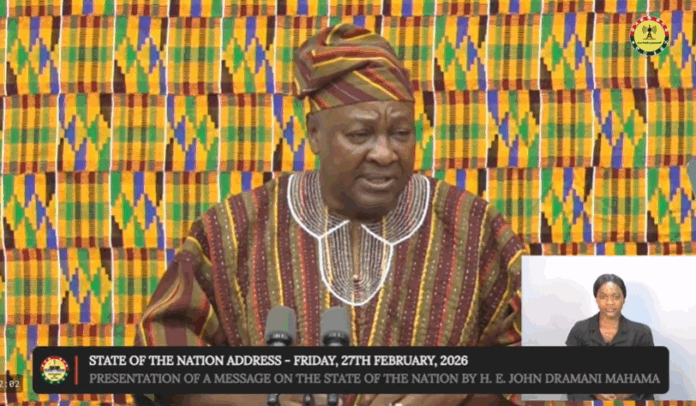

President John Dramani Mahama has unveiled an ambitious irrigation expansion programme aimed at transforming Ghana’s agricultural landscape, announcing plans for two large-scale dams and the rehabilitation of eight existing irrigation facilities.
Delivering the 2026 State of the Nation Address in Parliament, the President said the initiative is a central pillar of the government’s broader agricultural transformation agenda.
He explained that Ghana’s long-standing reliance on rainfall has left farmers vulnerable to erratic weather patterns and climate shocks, making irrigation a strategic necessity.
“The Feed Ghana Programme is firmly anchored on irrigation for world-class agricultural production. Government is deliberately shifting our agriculture from rain-fed dependence to irrigation-based farming to support continuous production and strengthen climate resilience,” he stated.
According to President Mahama, the two proposed mega dams will play a decisive role in stabilising water supply in key farming zones.
“These mega dams will provide a reliable water supply to thousands of farming communities, enabling continuous cultivation throughout the year. They are central to our vision of modernising agriculture and making it more climate-resilient,” he said.
Alongside the new projects, eight existing irrigation dams are being rehabilitated to restore their efficiency and maximise output. The President emphasised that upgrading current infrastructure is just as important as constructing new systems.
“Rehabilitating these dams ensures that our current infrastructure works at its full potential. It is part of a broader effort to modernise irrigation and secure sustainable agricultural growth,” he noted, adding that the upgrades will improve storage capacity, streamline water distribution, and make better use of available resources.
The programme also includes drilling 250 solar-powered boreholes targeted at farming communities and schools across the Northern Belt and Brong Ahafo regions, as well as the rehabilitation of major irrigation schemes such as Kpong and Aveyime.
In addition, new inland valleys spanning more than 1,300 hectares are being developed to boost rice production.
President Mahama said the irrigation expansion is designed not only to strengthen food security but also to generate employment and protect farmers against the growing threats of climate variability, ultimately positioning agriculture as a year-round engine of growth.
ALSO READ: