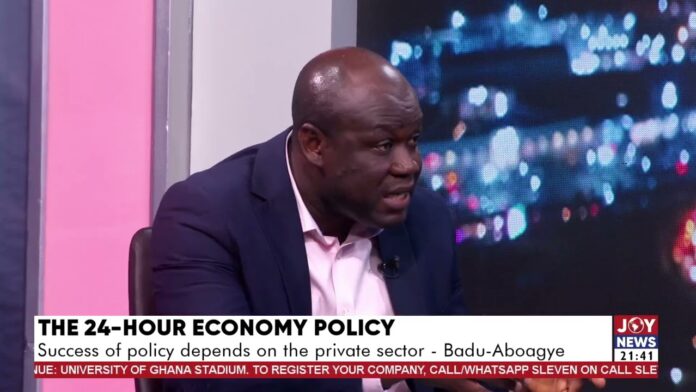

The Ghana National Chamber of Commerce and Industry (GNCCI) CEO, Mark Badu-Aboagye, says Ghana must not return to its old habits after exiting the International Monetary Fund (IMF) programme this year.
He warned that failure to manage the economy independently would make the country a permanent client of the Fund.
Speaking on Joy News’ PM Express Business Edition on Thursday, Mr Badu-Aboagye said Ghana’s repeated reliance on IMF support has become a cycle that must end, stressing that the reforms introduced under IMF programmes are not temporary measures but fundamentals the country must sustain.
“If we continuously do what we are doing, then that means that we should be under the IMF for life,” he said.
He argued that the country’s credibility will be tested after the programme ends, and that Ghana must demonstrate it can maintain fiscal discipline, implement reforms, and protect macroeconomic stability without external supervision.https://www.youtube.com/embed/_orS7g1swss?si=oFANUx7nzM98Agn0
“If after the exit of the IMF, we cannot manage our economy, then the IMF should bring their head office here and control us,” he stated.
Mr Badu-Aboagye’s comments come as Ghana targets an exit from its current IMF-supported programme this year, amid ongoing efforts to stabilise the economy after years of fiscal stress, currency depreciation, and rising debt.
For the GNCCI CEO, the problem has never been the IMF itself, but Ghana’s inability to sustain reforms after programmes end.
He said the country has already implemented the IMF’s recommendations, and those measures should not be abandoned simply because Ghana is leaving the programme.
“This is because all the things that they have asked us to do, that we have done, I think we should continue,” he said.
He cautioned that Ghana’s frequent returns to the IMF reflect a deeper governance challenge, where hard reforms are pursued under pressure but quickly discarded when the programme ends.
“There shouldn’t be any reason why we should deviate for these important fundamental changes that the IMF have brought to us; that is why we keep going there,” he said.
Mr Badu-Aboagye noted that Ghana’s history with the IMF has become too repetitive, citing the number of times the country has returned for support.
“I mean 17 times,” he said, stressing that such a record should compel policymakers to build stronger institutions and enforce long-term economic discipline.
He also challenged the public narrative surrounding IMF programmes in Ghana, where the Fund is often portrayed as a hostile force rather than a partner brought in to address economic mismanagement.
“And anytime you go there, it’s as if the IMF is a devil, that when they come, we don’t want to go there,” he said.
He argued that Ghana cannot keep blaming the IMF while repeatedly seeking assistance, adding that the country must take ownership of the reforms and treat them as national policy priorities.
Mr. Badu-Aboagye’s remarks reflect growing calls from the business community for Ghana to consolidate stability and build confidence for investment, particularly after the disruptions of recent years.
He insisted that exiting the IMF programme should not be treated as an end in itself, but as a turning point that demands greater discipline, stronger economic management and a clear commitment to maintaining the reforms already implemented.
ALSO READ: