
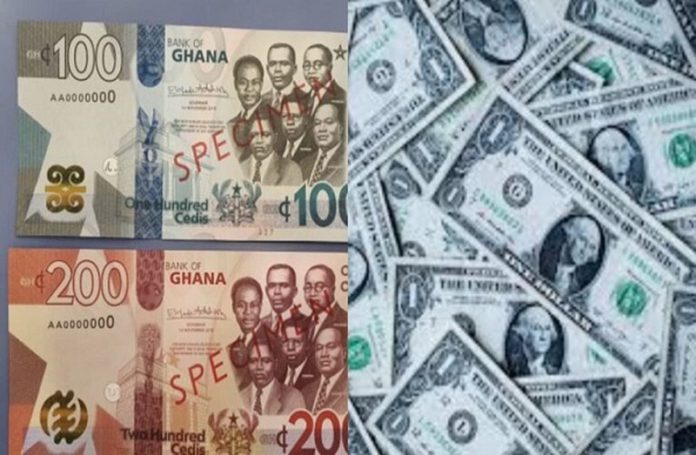

The Ghana cedi has continued to depreciate against major trading currencies over the past two weeks, with rising demand for foreign exchange and growing corporate repatriation needs intensifying pressure on the local currency.
The cedi, according to the latest market update, weakened in both the interbank and retail foreign exchange markets, with analysts attributing the depreciation to heightened demand for US dollars amid moderate foreign exchange supply.
The cedi traded at GHS 11.85 to the US dollar, down from GHS 11.63 recorded in the previous review period in the interbank market and also depreciated against the British pound and the euro, with exchange rates rising to GHS 15.85 per pound and GHS 13.66 per euro from GHS 15.62 and GHS 13.49, respectively.
The depreciation was also felt in the retail market, with the cedi losing 0.81 percent against the dollar, 1.83 percent against the pound, and 1.40 percent against the euro, closing at mid-rates of GHS 12.30 per dollar, GHS 16.35 per pound and GHS 14.30 euro.
Despite the foreign exchange interventions of approximately $1.1 billion by the Bank of Ghana in May, the cedi depreciated by an average of 4.18 percent between April and May 2026, compared to the 3.23 percent decline recorded at the end of April.
According to a report by citinewsroom.com, analysts have attributed the weakness to demand for foreign currency consistently outpacing supply, compounded by growing global appetite for the US dollar as central banks liquidate non-dollar assets to meet rising import costs driven by persistently high crude oil prices.
Looking ahead, market observers expect speculation in the foreign exchange market to remain relatively contained in June, supported by an announced $1.2 billion monthly foreign exchange support programme.
Analysts, however, warn that the cedi could face additional pressure in the coming weeks as multinational companies begin repatriating profits and dividends during the second-quarter repatriation period.
“Corporate demand typically peaks during the Q2 repatriation window, driven by multinational dividend and profit outflows,” the report noted.
The dollar-cedi exchange rate is expected to weaken further beyond the current interbank level of GHS 11.85 unless foreign exchange inflows strengthen significantly.
Meanwhile, in South Africa, the rand also came under pressure during the review period, weakening by 1.15 percent to close at ZAR 16.28 per US dollar.
Analysts attributed the decline to elevated oil prices and renewed geopolitical tensions that have dampened investor risk appetite and increased concerns over import costs.
The outlook for the rand remains cautious, with elevated crude oil prices and uncertain global market conditions expected to keep the currency under pressure in the near term.
